
Tour de Goa: A Medieval Watchtower Above the Conflent Valley
Perched high above the Conflent valley, the Tour de Goa is one of those places in the Pyrénées-Orientales that quietly rewards anyone willing to make the effort to reach it. Standing alone on a rocky hilltop above the village of Sahorre, the circular stone tower has watched over the landscape for centuries, offering sweeping views that stretch across the valley towards the Canigou massif and the surrounding mountains.
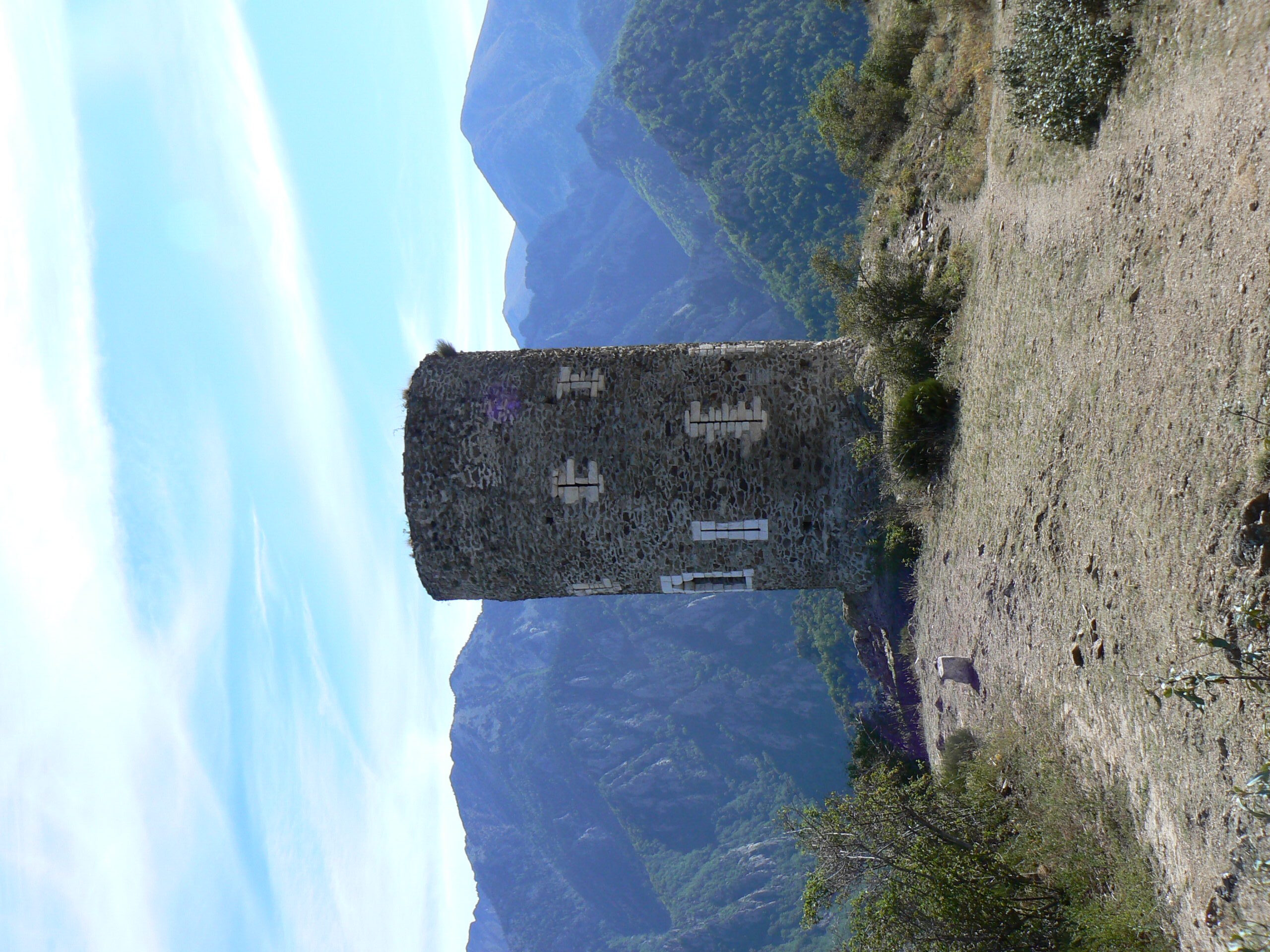
Today, the Tour de Goa is a peaceful destination for walkers, photographers and anyone looking for somewhere to escape into the mountains. But for centuries, this lonely tower had a very different purpose. It was part of a network of lookout and signal towers that allowed warnings to be transmitted across the landscape by smoke and fire.
And standing beside it today, with the valley spread out below, it is remarkably easy to understand why this particular hilltop was chosen.
ALL ALONG THE WATCHTOWERS
A Tower With a Purpose
The exact origins of the Tour de Goa are not completely certain. The tower is generally dated to the 13th or 14th century, although the wider network of signal towers in this part of the Pyrenees dates back as far as the 11th and 12th centuries.
The first known written reference to the tower dates from 1389, when it appears as Turris de Goa. By 1670, another document referred to it as Goua.
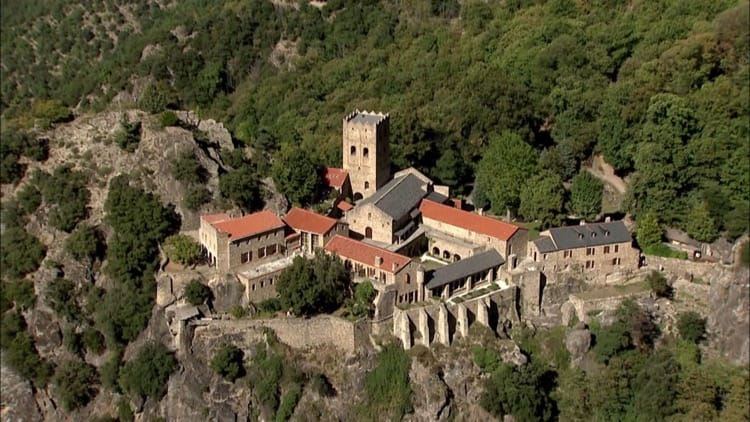
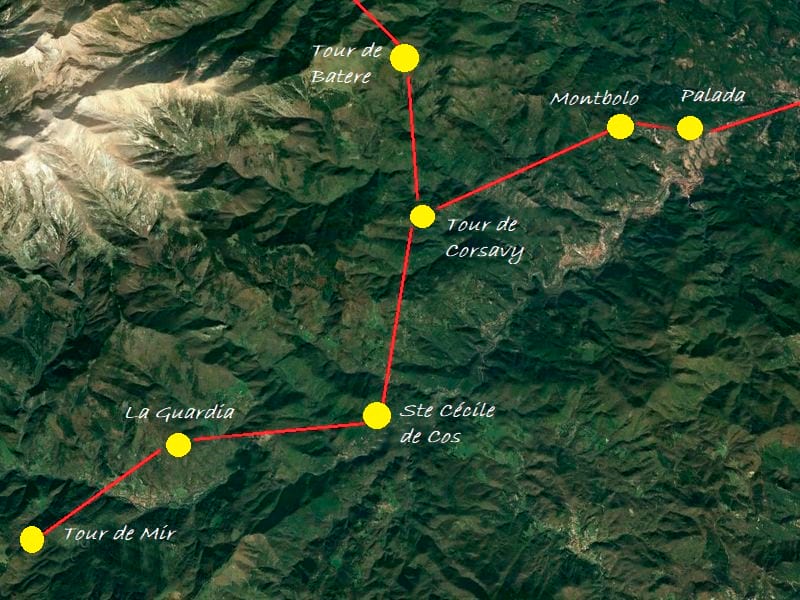
These towers formed a communication system designed to relay signals between strategic points across the Pyrenees, and specifically towards the comtal château and a group of fortified and religious sites, including the Abbey of Saint-Martin-du-Canigou.
By using smoke during the day and fire at night, messages could be passed rapidly from tower to tower, warning of approaching threats.
Its role was to watch over the surrounding territory and relay warnings when danger threatened. During the day, signals could be made using thick smoke; at night, a large fire was lit. The night-time fires had a particularly evocative local name: “alimaries”, meaning illuminations.
The system relied on something that seems almost magical today: line of sight.
From the Tour de Goa, signals could be passed between a remarkable chain of towers, castles and fortified sites. The heritage inventory records a visual network extending across roughly 50 kilometres, including the towers of Badabany, Llar and Cabrils, the château d’Eus, the château de Comes, the Tour d’Arboussols and the Tour del Far, around 44 kilometres away.
In other words, the tower was not simply a lookout standing alone on a mountain. It was one small part of a sophisticated communications system spread across the medieval landscape.
Watching the Mountains
The view from Goa explains everything.
The tower stands on a rocky plateau along a ridge, with an almost unobstructed view across the surrounding valleys and mountains. It could communicate with the towers of Badabany, while signals were also passed towards important fortified and religious sites, including the Abbey of Saint-Martin-du-Canigou.
That connection makes the landscape particularly fascinating today. Look across the mountains and the famous abbey can be understood not just as a spectacular medieval building, but as part of the same historic world as the tower.
Imagine standing here centuries ago.
There are no roads winding through the valley, no electricity pylons and no modern buildings dominating the view. Instead, a watchman would have been looking for another tower, another hilltop and, most importantly, the appearance of smoke or fire.
One signal would become another.
A warning could leap from ridge to ridge
A Network That Has Mostly Disappeared
The Tour de Goa was connected to two other signal towers at Badabany, near the junction of the territories of Corneilla-de-Conflent and Fuilla.
One was known as the Petite Tour, while the larger Tour Grosse probably dates from around the 13th century. Only the foundations and a cistern of the latter survive today.
The two Badabany towers were eventually demolished on the orders of the military engineer Vauban after 1659.
This gives the Tour de Goa an added significance. It is not simply an old tower that happens to have survived. It is one of the remaining pieces of a much larger defensive landscape that has largely disappeared.
The Setting
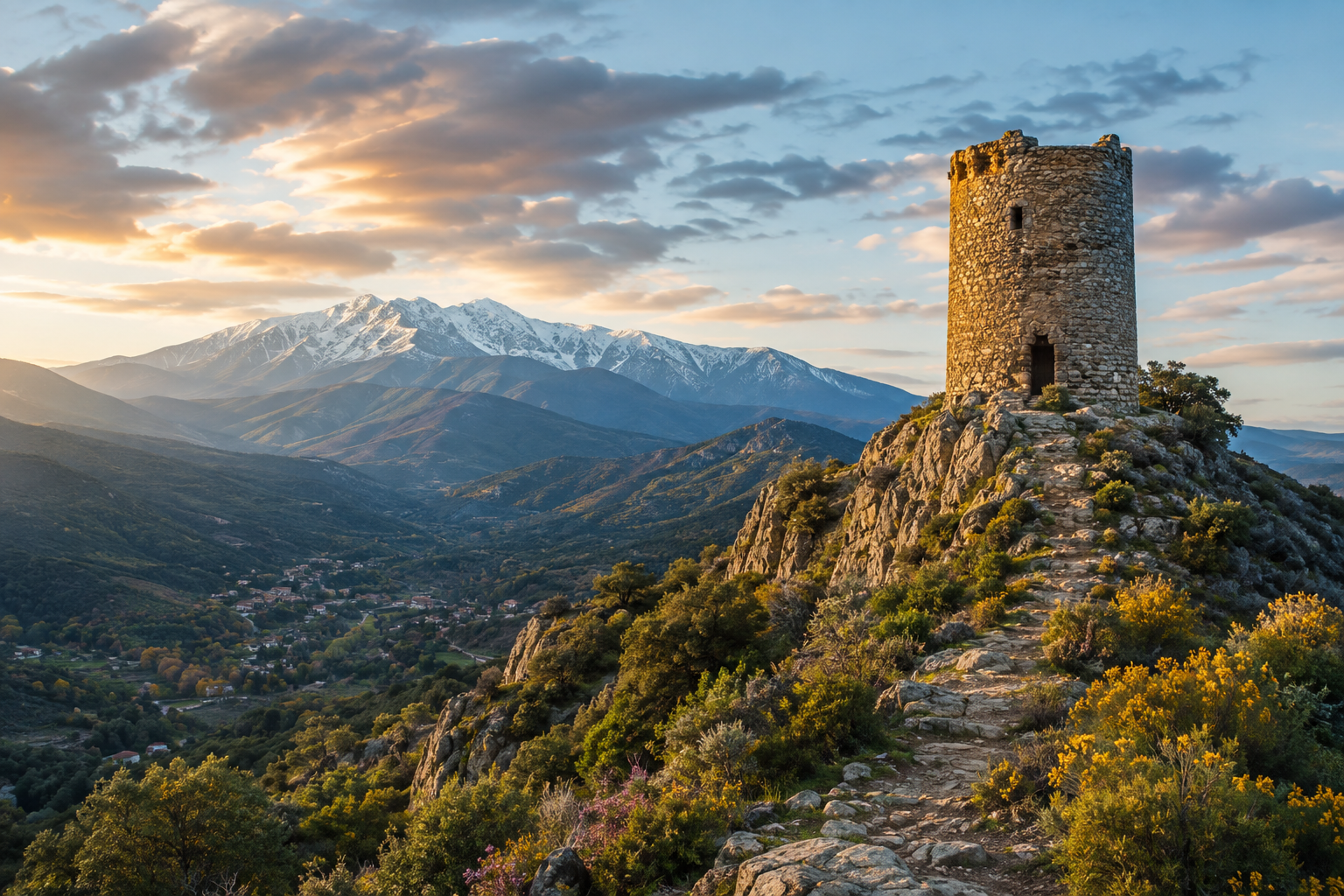
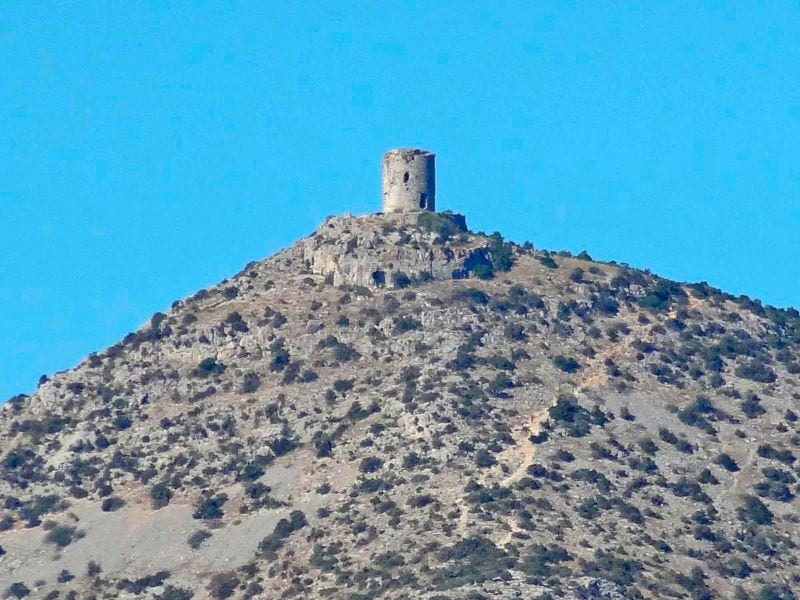
The tower sits on a rocky promontory surrounded by Mediterranean vegetation, with the mountains of the Canigou massif rising dramatically in the distance. Below, the Conflent valley stretches out with its patchwork of forests, villages and winding roads.
The scenery changes with the seasons. In spring, the slopes are dotted with wildflowers and fresh green foliage. During the summer months, the dry hillsides take on warmer tones, while the higher peaks remain cooler and often clearer in the distance. Autumn brings softer colours to the valley below, while winter can occasionally dust the surrounding mountains with snow.
It is a landscape that feels both expansive and quiet at the same time.
The Tower Itself
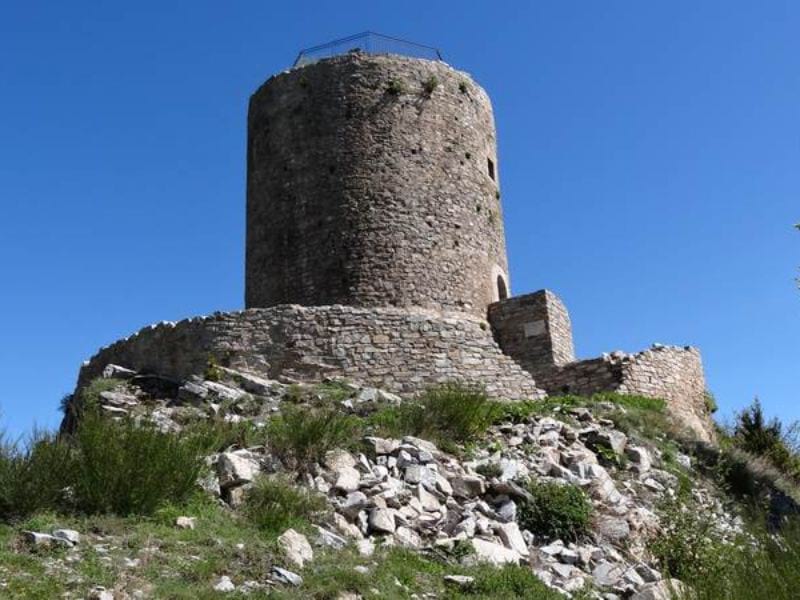
The tower is surprisingly compact. It is approximately 6 metres in diameter and 11 metres high, making it roughly twice as high as it is wide.
Inside are two vaulted levels, originally separated by a wooden floor. The walls contain narrow arrow slits, arranged alternately between the two levels. Some of the openings were constructed using carefully worked white marble from nearby Py, contrasting with the rougher granite, gneiss and schist used elsewhere in the walls.
The architecture also leaves some questions unanswered.
Some specialists have suggested a 13th-century date based on the form of the arrow slits, while other evidence points towards the 14th century. There is also a possibility that the tower was used for observation by the monks of Saint-Martin-du-Canigou, whose abbey is directly overlooked by the ridge.
So although the broad story of the tower is clear, its earliest history still contains a little mystery.
And perhaps that suits the place.
Still On Duty Centuries Later
The Tour de Goa was not simply abandoned after the Middle Ages.
Records show that it was still being used for military purposes in the 17th century. In 1670, expenses were recorded for the guard of troops stationed at the tower.
By then, the world around it had changed dramatically, but the strategic advantage of its position remained.
The tower continued to watch the mountains.
Eventually, however, its military importance faded, leaving the stone structure exposed to the elements and the passage of time.
The tower was later restored in 1990 during a volunteer heritage project organised with the support of local and regional authorities and the heritage organisation Union Rempart. It received a national award for the restoration project. The Tour de Goa has been protected as a historic monument since 21 December 1982.
Stories and Legends
Look towards the Canigó from the Tour de Goa and you’re looking at a landscape filled with legends. One ancient Catalan tale tells of seven giants who tried to build a staircase to heaven, piling enormous stones towards the sacred mountain. The gods responded with thirteen furious winds, earthquakes and fire, turning the giants themselves to stone. Their petrified forms are said to survive in the mountains around Canigó.
It is only a legend, of course.
But standing on a medieval tower above the Conflent, looking towards the immense bulk of Canigó, it is easy to understand how such stories took root.
A medieval account tells of King Peter II of Aragon attempting to climb Canigó. At the summit, according to the legend, he discovered a lake. When he threw a stone into it, a huge dragon emerged from the water, breathing fire and filling the sky with smoke. The story is one of the traditions associated with the mountain’s later reputation as a sacred and mysterious place.
Walking to the Tower
There are several ways to reach the Tour de Goa, depending on how challenging a walk you are looking for.
One of the most popular routes begins in Vernet-les-Bains, a historic spa village at the foot of the Canigou. From here, a marked trail climbs steadily through woodland before reaching the higher ridges that lead towards the tower.
This route offers a rewarding journey through varied terrain, with changing views of the surrounding mountains and the valley below. Along the way, walkers often catch glimpses of other landmarks in the region, including the famous Abbaye Saint-Martin du Canigou, perched dramatically on its own rocky spur.
For those looking for a shorter walk, it is also possible to approach the tower from the Col de Jou, reducing the distance to a much easier outing.
Whichever route is chosen, the final approach to the tower always feels special. As the path climbs over the last stretch of rocky ground, the tower gradually comes into view, standing quietly against the sky.
A Place to Pause
Arriving at the Tour de Goa offers a natural moment to stop and take in the surroundings. The open hillside around the tower provides space to sit, rest and enjoy the views.
From this vantage point, the Conflent valley lies spread out below, while the silhouette of the Canigou dominates the horizon. On clear days, the sense of distance and openness is striking.
It is a place that invites a slower pace, where the atmosphere of the mountains and the long history of the tower seem to blend together.
And perhaps the most fascinating thing is to remember that the people who stood here centuries ago were looking at almost the same landscape.
They simply had something very different to look for.
A Hidden Corner of the P-O
Although the Pyrénées-Orientales is known for its coastline and lively villages, places like the Tour de Goa reveal another side of the region. Here, just a short distance inland, the landscape becomes quieter and more rugged, shaped by centuries of history and the natural beauty of the Pyrenean foothills.
For walkers, photographers or anyone who enjoys discovering lesser-known places, the Tour de Goa is a reminder that some of the most memorable spots are often found away from the obvious routes.
And from its hilltop above Sahorre, the tower continues to do what it has done for centuries — quietly watching over the valley below.