
Shadows on the Canigou; Article 5
Shadows on the Canigou; Article 5
Henri Treyeran: The Most Hated Man in Perpignan
The Milice leader who was shot in his own tobacconist’s shop
There are people whose names survive because they became heroes.
Others are remembered because they became villains.
Henri Treyeran belongs firmly to the second category.
During the Occupation, he became one of the most prominent figures in the Milice in the Pyrénées-Orientales.
By early 1944, the Resistance had decided that he had to die.
On a winter day in Perpignan, a Resistance gunman walked into the city centre and killed him.
The story sounds simple.
It wasn’t.
A Familiar Face
One of the most unsettling things about the Occupation was how ordinary everything could look.
Perpignan’s streets were still busy. Shops opened. People went to work. Cafés filled with customers.
And in the middle of this apparently normal life, the machinery of repression was operating.
Henri Treyeran was not a German soldier.
He was French.
He was also a local businessman.
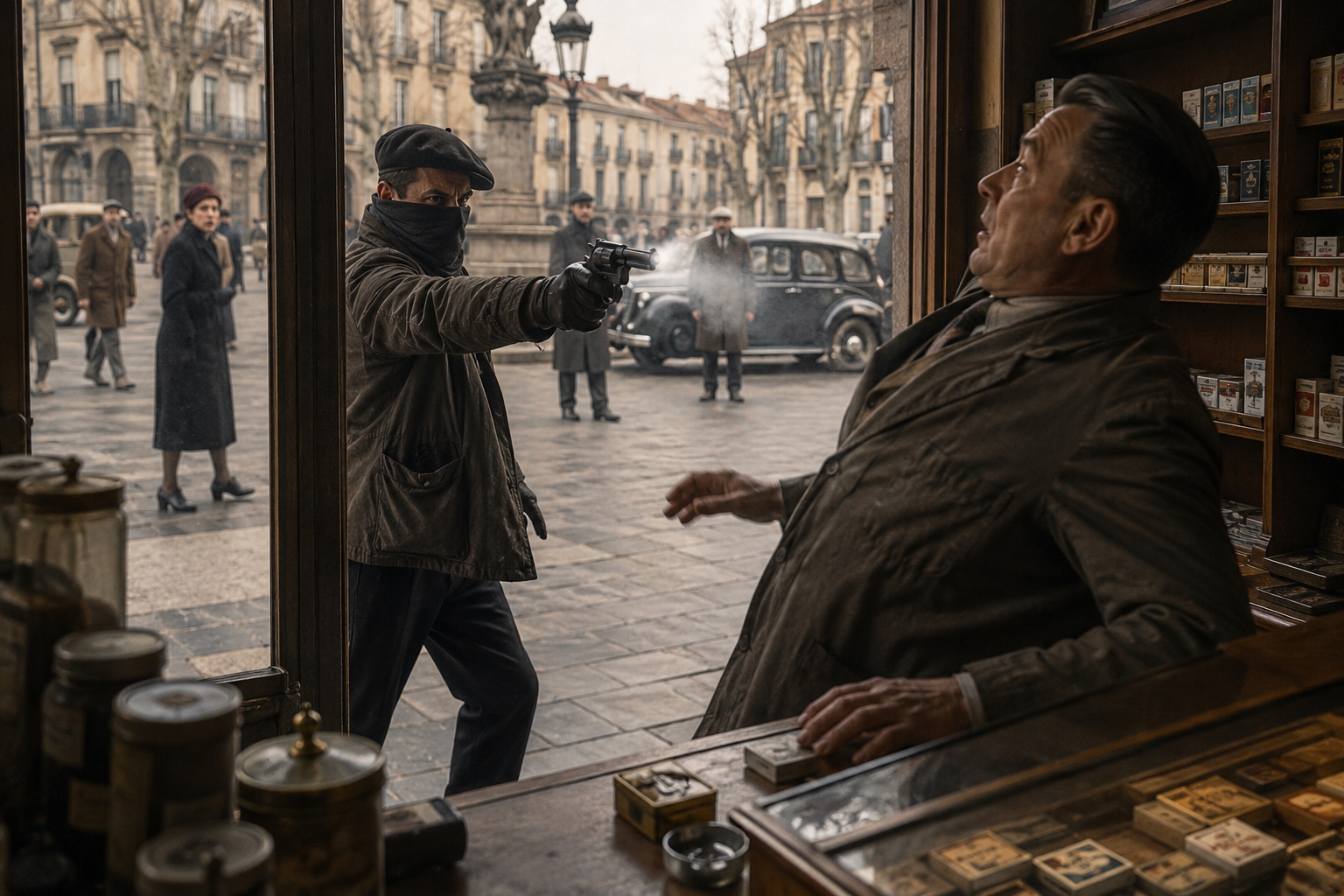
Treyeran was a buraliste, a tobacconist, whose shop was on Place Arago.
It was an ordinary civilian occupation in an increasingly extraordinary time.
But Treyeran had another role.
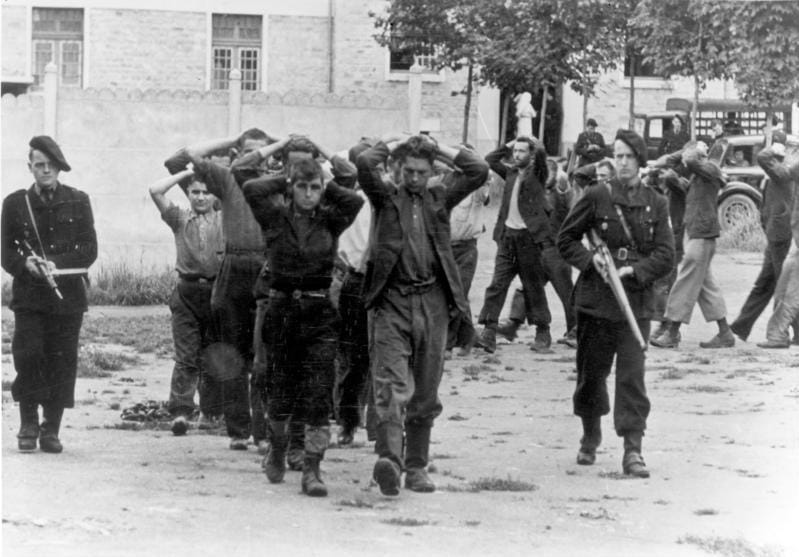
He was deputy head of the Milice in the Pyrénées-Orientales — one of the senior local figures in an organisation whose purpose had increasingly become the suppression of Resistance activity.
The Milice had originally emerged from the Service d’ordre légionnaire, or SOL, and became the Milice française in 1943. In the Pyrénées-Orientales, collaborationist organisations had attracted hundreds of members, although many were never involved in the most violent activities.
Treyeran, however, occupied a position of responsibility.
And that made him a target.
The Milice Takes the Fight to the Resistance
By the beginning of 1944, the conflict in the department was becoming increasingly vicious.
The Resistance sabotaged railway lines, attacked German interests and built networks of escape and concealment.
The Germans responded with arrests and repression.
But they were increasingly dependent on French collaborators who knew the area and, crucially, knew the people.
The Milice could identify local families, recognise suspected resistance sympathisers, ask questions in the cafés, shops and villages where a German officer might attract immediate suspicion.
For Resistance fighters, this made the Milice particularly dangerous.
And for Milice officers, the war was becoming personal.
They were no longer simply enforcing the policies of Vichy.
They were helping hunt their own countrymen.
A Decision Was Made
By the winter of 1943–44, the Resistance had begun carrying out targeted attacks against collaborators.
These were not random acts of violence.
At least in principle, the purpose was to remove individuals regarded as particularly dangerous and to disrupt the machinery of repression.
Henri Treyeran was one such target.
The decision appears to have been linked to the Groupes francs de Libération, armed Resistance units operating under the authority of Louis Torcatis.
Torcatis was an important figure in the Resistance movement in the region. According to the historian Jean Larrieu, one of the armed actions carried out by groups under Torcatis’s authority was the execution of Henri Treyeran, described as the deputy departmental head of the Milice in the Pyrénées-Orientales.
Someone was sent to Perpignan. Someone who knew exactly who he was looking for.
Place Arago
It was early February 1944.
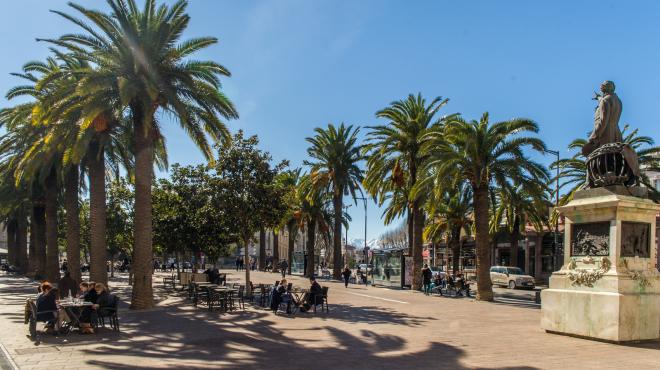
Treyeran was at his tobacconist’s shop on Place Arago, not some isolated mountain hideaway. It was in the heart of the city.
People were coming and going.
The attack was sudden.
Treyeran was shot twice with a revolver. Then the gunman disappeared.
The man who had spent his days helping the Milice hunt Resistance members had himself been hunted.
Now he was dead.
The Message
The assassination sent a message far beyond Treyeran himself.
The Resistance could reach collaborators in the centre of Perpignan.
No office, uniform or position could guarantee safety.
For the Milice, it was a warning. They were no longer simply the hunters. They were targets.
And the response was not to retreat. It was to become more aggressive.
The winter and spring of 1944 saw an intensification of arrests and repression throughout the department. Resistance networks were increasingly penetrated, informers were used, and suspected sympathisers faced growing danger.
Within weeks, the violence would claim another of Perpignan’s best-known Resistance figures.
In March, Gilbert Brutus was arrested. He would die after being tortured in the Citadel.
The cycle was accelerating.
Assassin or Resistance Fighter?
Today, the word assassination can feel uncomfortable when describing an act carried out by the Resistance.
Was Treyeran assassinated? Yes.
Was he executed? That is how some Resistance histories describe it.
Was it an act of terrorism?
The answer depends largely on the language and political perspective used to describe the Occupation.
For those who opposed the Germans and Vichy, Treyeran was a collaborator and an enemy of the Resistance.
For the French state after Liberation, collaboration with the enemy would become a criminal matter.
But in February 1944 there was no liberated French government in Perpignan capable of putting Treyeran on trial.
There was occupation. There was clandestine warfare. And there was violence on both sides.
That does not make every action morally equivalent.
The Milice was part of a system of repression operating alongside German occupation authorities. Resistance groups, meanwhile, were fighting an occupying power and those French organisations that actively assisted it.
But the assassination of Treyeran remains a reminder that the Resistance was not simply a story of heroic sabotage and secret messages.
It was also a war.
The Man Behind the Name
We know little about Henri Treyeran.
History has preserved his position and his death much more clearly than his personality.
We know that he was a tobacconist. We know where his shop was. We know that he became deputy head of the local Milice. We can guess that he was the instrument of much torture, death and many disappearances.
We know that the Resistance considered him important enough to target. And we know how his life ended.
But the surviving accounts tell us little about the man before the war. The temptation with historical villains is to fill the gaps with assumptions.
What we can say is that by 1944 Treyeran had become part of the local apparatus of collaboration and repression — and that, in the eyes of the Resistance, this was enough to make him a legitimate target.
A City at War with Itself
Treyeran’s death also tells us something important about Perpignan during the Occupation.
A Resistance fighter could be sitting in a café beside someone who informed for the Milice.
A shopkeeper could secretly pass information to the Resistance while serving customers who supported Vichy. A neighbour could disappear overnight. And somewhere in the city, someone might already be watching.
The danger was not always visible.
That was what made the Occupation so frightening.
The Beginning of the End
When Treyeran was killed in February 1944, Liberation was still six months away.
The Germans were still in control. The Milice was still operating. The Resistance was still underground.
Nobody in Perpignan could know exactly how the final months would unfold.
But the assassination of Henri Treyeran was one small sign that the balance was beginning to change.
The Resistance was becoming bolder. The collaborators were becoming more desperate.
And the violence was escalating.
By August, the Germans would be retreating.
The Milice would be running.
And men who had spent years hunting the Resistance would themselves be hunted.
But that is another story.
Articles In This series
Article 1
The Traitor of Valmanya: The Strange and Tragic Story of Nessim Eskenazi
Article 2
Julien Panchot: The Maquis Leader Who Refused to Break
The story of the Resistance commander captured before the destruction of Valmanya.
Article 3
Valmanya 1944: The Village That Burned
A dramatic reconstruction of the attack on the village and its aftermath.
Article 4 Part 1
The Milice in Perpignan
Who collaborated locally, how the organisation operated, and how it was dismantled after Liberation.
The Milice in Perpignan Part 2
Who collaborated locally, how the organisation operated, and how it was dismantled after Liberation.
Article 5
Henri Treyeran: The Most Hated Man in Perpignan
A profile of the Milice leader assassinated by Resistance fighters.
Article 6
Escape Across the Pyrenees
The guides, smugglers, Allied airmen, Jews and resistance fighters who crossed into Spain.
Article 7
The Women of the Resistance in the Pyrénées-Orientales
Too often overlooked
Article 8
The Liberation of Perpignan
August 1944 and the collapse of German authority.
Article 9
Justice and Revenge
The trials, executions, and purges that followed Liberation.
Article 10
The Last Witnesses
How the Occupation is remembered today in the department.