
Dealing with some of the unwanted visitors that make themselves at home in the south of France
Living in the south of France comes with plenty of perks. Sunshine, outdoor living, long summer evenings and doors and windows flung open to let in the breeze.
Unfortunately, sometimes the breeze isn’t the only thing that comes in.
A line of ants can appear across the kitchen almost overnight. That occasional scratching from somewhere above the ceiling can suddenly become a nightly occurrence. And anyone who has watched a wasp disappear repeatedly into the same tiny hole beneath a roof tile has probably had the same thought: just how many of them are in there?
Sharing our corner of France with insects and wildlife is all part of life here and, for the most part, they are best left alone. But when something decides to move into your home, roof, walls or garden in numbers, it can be a different story.
So, what should you look out for, what can you tackle yourself and when might it be time to call in the professionals?
The great ant invasion
One ant isn’t particularly concerning. Twenty marching purposefully across the kitchen worktop is another matter.
Ants are one of those problems that can seemingly appear from nowhere. Once they’ve found a reliable food source, however, you may find yourself wiping down the worktop only to discover another little procession has appeared an hour later.
Keeping food sealed, cleaning up crumbs and spills and working out where the ants are getting in can help with minor problems. The difficulty comes when the nest isn’t actually somewhere you can reach.
Repeatedly killing the ants you can see may do very little to address a larger colony hidden elsewhere in or around the property.
If the same problem keeps returning despite your best efforts, it may be worth finding out exactly what you’re dealing with rather than continuing the battle one ant at a time.

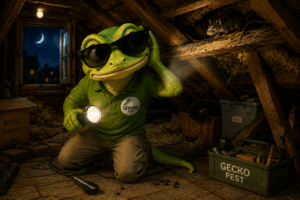
What’s scratching in the roof?
There’s something particularly unsettling about lying in bed and hearing a noise coming from somewhere that definitely shouldn’t be making a noise.
Scratch. Scuttle. Silence.
Was that the house settling?
Scratch.
Probably not.
Rats and mice can find their way into surprisingly small spaces and may settle in roofs, attics, garages, outbuildings and wall cavities. And while you may not actually see your new resident, there can be other clues.
Droppings, gnaw marks, damaged food packaging, unusual smells and noises at night can all warrant a closer look.
Rodents aren’t simply annoying house guests. They can damage insulation, belongings and even electrical wiring, so signs of an infestation are worth taking seriously.
Wasps and hornets: when a nest gets too close for comfort
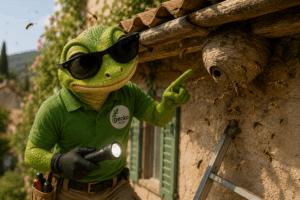
Wasps are part of summer life and seeing a few buzzing around outside doesn’t mean you have a problem.
Finding a steady stream of them entering and leaving the same spot in your roof is rather different.
Nests can turn up in roof spaces, wall cavities, sheds, trees and other sheltered locations. Often they can simply be left alone if they’re well away from people, but a nest close to a doorway, terrace or frequently used part of the property can become difficult to ignore.
This is also one of those occasions when enthusiasm and a can of insect spray aren’t necessarily the best combination.
If you don’t know the size or exact location of a nest, or you’re dealing with insects that could become aggressive when disturbed, getting professional advice is generally the safer option.
The holiday souvenir nobody wants
Some unwanted visitors don’t come in through the window. We bring them home ourselves.
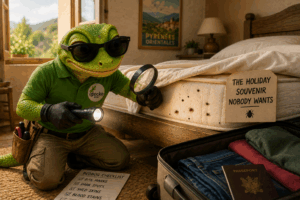
Bedbugs are excellent hitchhikers and can travel in luggage, clothing and other belongings. They’re also notoriously difficult to deal with once established.
The first sign isn’t always seeing an actual bedbug. Small marks on bedding, bites, shed skins or tiny dark spots around mattresses and bed frames can all prompt suspicions.
And despite the stigma that sometimes surrounds them, bedbugs aren’t a sign of a dirty home. They can turn up almost anywhere.
If you suspect bedbugs, identifying the problem correctly is particularly important. Treating the wrong thing wastes time and can allow an infestation to become more established.
And then there are the cockroaches…
There are few moments in life when you become quite as fast as when something brown with too many legs suddenly darts across the kitchen floor.
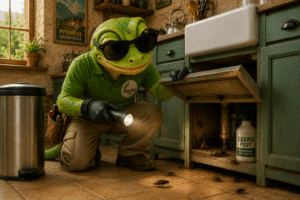
Cockroaches are another pest where seeing one can raise the uncomfortable question of whether there are others hiding nearby.
Warm, sheltered spaces with access to food and water are attractive to them, and kitchens, bathrooms, utility areas and drains can all provide suitable conditions.
Keeping food properly stored, bins covered and surfaces clean can make a property less inviting, but an established infestation can be much harder to tackle without identifying where the insects are hiding and breeding.
Don’t forget the pets
Sometimes the culprit is considerably smaller.
Fleas can enter the home via cats, dogs and other animals, and once they’re established they don’t necessarily stay on the pet.
Eggs and developing fleas can be present in carpets, bedding, furniture and cracks around the home, which is one reason a persistent flea problem can feel as though it keeps coming back no matter how much cleaning you do.
Treating pets appropriately is important, but a significant household infestation may need a wider approach.
When is DIY enough?
Not every insect requires a pest controller.
A spider in the corner of the room probably doesn’t warrant sounding the alarm, and many small, isolated pest problems can be dealt with by removing food sources, blocking entry points and keeping the property clean and well maintained.
The time to reconsider the DIY approach is when the problem keeps coming back, appears to be spreading, involves a nest or colony you can’t safely access, is causing damage or you’re simply not sure what you’re dealing with.
And that’s where being able to explain the problem properly can make life considerably easier.
Pest control, but in English
Trying to explain that something is living above the bedroom ceiling, you’re not entirely sure what it is, but it’s definitely scratching at 2am can test even fairly respectable French.
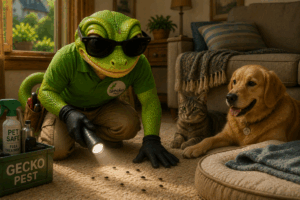
Gecko Pest provides professional pest control in English across the Pyrénées-Orientales, Aude and Hérault, helping homeowners and landlords deal with everything from ants, rats and mice to wasps, hornets, bedbugs, fleas and cockroaches.
With more than a decade of residential pest control experience, Gecko Pest offers a particularly useful service for English-speaking residents, second-home owners and landlords who want to be able to explain exactly what’s happening and, equally importantly, understand what’s going to be done about it.
They can also help with other unwelcome visitors, including spiders, flies, centipedes, stink bugs and birds.
Prevention is usually easier than eviction
Of course, the ideal scenario is not having to evict anything in the first place.
Sealing obvious gaps around doors, pipes and walls, storing food securely, keeping bins closed, checking roof spaces and outbuildings periodically and avoiding easily accessible food and water sources can all make your property less attractive to pests.
For second-home owners in particular, it’s worth having a good look around after a property has been empty for some time. Check cupboards and food stores, look for droppings or signs of gnawing, pay attention to unusual smells and have a glance around roofs, shutters, terraces and outbuildings for nests or insect activity.
Most of the wildlife around us belongs exactly where it is and causes us no trouble whatsoever.
But if something has decided that your kitchen, attic or spare bedroom would make an excellent new home, you don’t necessarily have to share.
Got an unwanted house guest?

Gecko Pest offers English-speaking pest control services throughout the Pyrénées-Orientales (66), Aude (11) and Hérault (34).
Whether you know exactly what’s moved in or have absolutely no idea, you can contact Gecko Pest to discuss the problem and find out what to do next.
Telephone: 09 71 24 74 05
WhatsApp: 07 81 23 48 87
Email: info@geckopest.fr
Website: geckopest.fr