
UPDATED SEPTEMBER 2026
WALK Força Réal
Starting off at Millas, on the N116 between Perpignan and Ille sur Têt, follow the signs towards our destination, Força Réal.
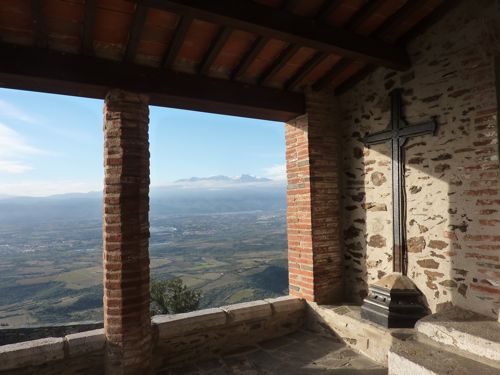
Situated between Millas, Corneilla-la-Rivière and Montner, at an altitude of around 507 metres, the panorama from this stunning view point extends along the coastline from Port-Vendres to Leucate, across the Agly and Têt valleys, over the Albères, Canigo, Carlit… Truly fabulous.
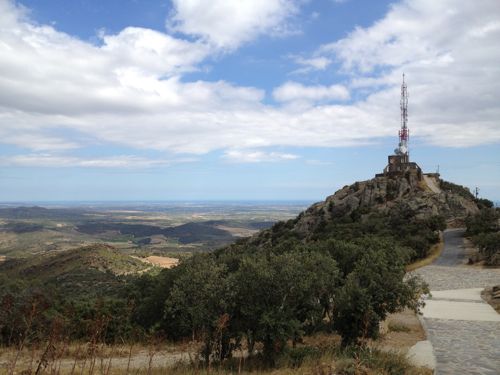
Over the years, Força Réal (Royal Fortress) has been many things to many people! Signal tower and fortress for the defence of the Roussillon, welcoming beacon landmark for returning fishermen, hermitage, and today a ‘tour de guet’ for fire spotting. On a clear day, the view will take your breath away.
Following the Treaty of Corbeil in 1258, the kings of Aragon and Majorca developed the site as part of the northern defences of the Roussillon. A signal tower and small fort were constructed on the two adjacent hills, but the fortress eventually lost its military importance and was destroyed in the 17th century.
The site was subsequently transformed into an hermitage and ‘Conjurador’, whose traditional function was to appease the elements and ward off storms and summer drought.
For the more energetic, a labyrinth of well-signed walks for all levels, with ‘sentier botanique’ identifying trees and shrubs, will take you up to a large viewing platform, looking out over the wine villages of Montner, La Tour de France to your far left, Estagel in the distance. Further afield the Corbières and Queribus.
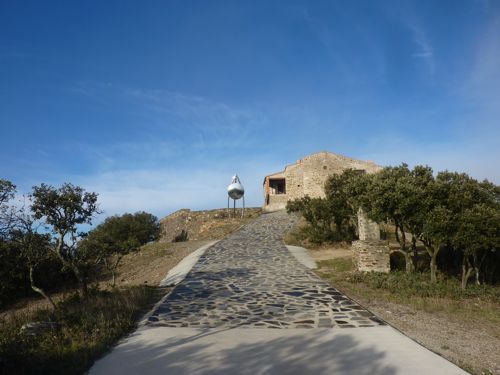
If you simply prefer a pleasant drive all the way up to this panoramic viewpoint and picnic spot, take the RD 38, from the Col de la Bataille.
The Col de la Bataille is itself steeped in history. The name is traditionally associated with a battle fought here in 1496, when the area lay on the frontier between the kingdoms of France and Aragon. The col later became an important crossing between the valleys of the Têt and the Agly.
The col is also a poignant memorial to members of the resistance group Henri Barbusse, a reminder of courageous men and women who gave up their lives for the liberty which today we take so much for granted.

Follow the winding road up to the large free car park and a short five minute climb will take you up to the pretty chapel with orientation table, passing the fascinating polished steel convex mirror which reflects back the enormous views around you.
Unfortunately, the chapel is rarely open, although religious celebrations and processions continue to take place there on particular feast days.
A path to your left takes you to the main viewpoint with a telecommunications mast (which somehow manages not to spoil the views) and a fire watching hut. In summer, volunteers with binoculars and walkie-talkies, linked directly to the emergency services, are on constant alert throughout the day.
A visit to Força Réal is not recommended on a windy day, unless you wish to lose your hat and anything else that’s not well secured to your body!
Back in Millas, olive-oil fans will not want to miss a visit to nearby Moulin Saint Pierre, a small detour on the route to Thuir. The family-run business is now in its seventh generation, with Manon and her brother Victor Planes carrying on the family tradition. Visitors can enjoy a free visit and tasting and discover how the modern mill processes its olives.
Although there are several other olive oil mills in the area, what makes Moulin Saint Pierre stand out are the wonderful views across to Força Réal and the interesting on-site house, where the current owners live. Its désigner was fashionable Danish architect, Viggo Dorph-Petersen, who also designed Château d’Aubiry in Céret, Château Valmy in Argèles and Château Ducup St Paul in Perpignan – to name a few!