
FROM FACEBOOK TO THE STREETS: THE STORY OF THE GILETS JAUNES
Could the Gilets jaunes, or Yellow Vests, become a significant force on the streets of France again?
The movement that shook the country in 2018 and 2019 never entirely disappeared but certainly lost its momentum despite various vague and mainly unsuccessful calls to action over the past years. Could renewed protests over the cost of living and government policies be about to bring them back into the headlines?
To understand how it all began, it is worth looking back at the movement’s remarkable origins — and how an online protest became a nationwide demonstration of public discontent.
It all started on Facebook
In October 2018, plans to increase fuel taxes, with further rises expected, helped ignite public anger. A video posted on Facebook by Jacline Mouraud, a musician and hypnotherapist from Brittany, went viral. In it, she challenged President Emmanuel Macron over the financial pressures facing ordinary people, particularly motorists who depended on their cars.
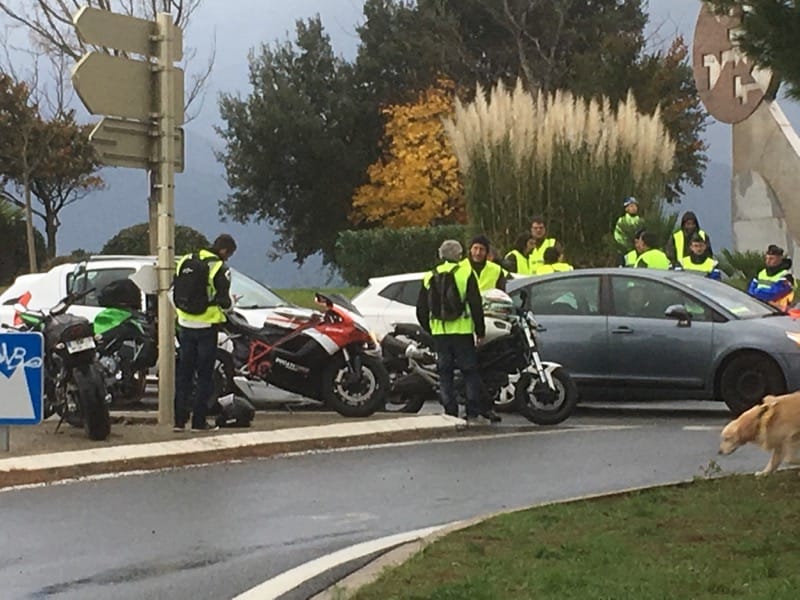
As support grew online, people began organising through social media. The idea of wearing the yellow high-visibility jackets that French motorists are required to keep in their vehicles provided a simple, instantly recognisable symbol of solidarity.
The name Gilets jaunes was born.
Mouraud subsequently faced hostile messages and online abuse, including threats and insults. The controversy highlighted how quickly a protest movement could turn individuals who spoke out into targets.
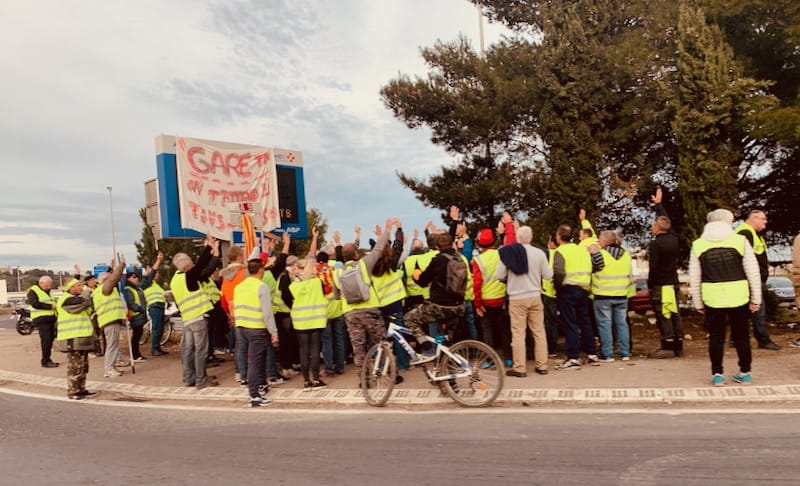
The first nationwide day of action took place on Saturday 17 November 2018. Around 280,000 people took part in demonstrations and road blockades at thousands of locations across France, according to official figures. Motorists blocked roundabouts, slowed traffic and gathered on roads to protest against fuel costs and what they saw as an unfair burden on working households.
What had begun as an online campaign had become a major national movement.
How did the government get caught out?
One of the most striking features of the Yellow Vests movement was how quickly it gathered momentum.
Social media enabled people who felt ignored by established political parties and trade unions to connect directly with one another. They could share their frustrations, organise local actions and spread calls for demonstrations without needing a traditional organisation to lead them.
The government initially appeared unprepared for the scale and intensity of the anger. The fuel-tax proposals had become a symbol of something much bigger: a widespread feeling that political decision-makers did not understand the everyday financial pressures facing ordinary people.
The movement also proved difficult to negotiate with. Unlike a traditional trade union dispute, there was no single leader or representative who could speak for everyone or agree to a settlement on behalf of the protesters.

So, who are the Gilets jaunes?
In principle, the Yellow Vests were not affiliated with any single political party, trade union or established organisation. They brought together people from a wide range of backgrounds and political viewpoints.
That independence was both a strength and a weakness. It allowed people who might never otherwise have demonstrated together to unite around shared grievances. However, it also meant that the movement had no agreed programme or leadership structure capable of representing all its supporters.
Political parties across the spectrum attempted to respond to the protests, with some seeking to associate themselves with the movement’s demands. President Macron’s party, then known as La République En Marche!, was among those facing criticism from protesters.
There was no single explanation for the movement’s popularity, but the pressures facing motorists were central to its early success.
Why fuel prices struck such a nerve
For many people living outside France’s major cities, a car is not a luxury. It is essential for getting to work, taking children to school, shopping and accessing healthcare.
Public transport in many rural areas and smaller towns is limited, leaving residents with few alternatives to driving.
Fuel-tax increases therefore had a particularly significant impact on households already struggling to make ends meet. The issue also touched a sensitive nerve among motorists who had previously been encouraged to choose diesel vehicles as a more environmentally friendly option, only to find themselves facing rising fuel costs and growing restrictions on diesel use.
For many protesters, the issue was not simply the price of petrol or diesel. It was the feeling that environmental policies and tax increases were placing a disproportionate burden on people who had little choice but to drive.
As the demonstrations continued, the demands broadened. Purchasing power, wages, pensions, taxation, public services and the perceived distance between political leaders and ordinary citizens all became part of the debate.
A recurring question was whether the financial burden was being shared fairly. Many protesters felt that middle-income households were being squeezed: earning too much to qualify for some forms of assistance, but not enough to feel financially secure.

Why didn’t the movement simply disappear?
As the demonstrations entered their fourth week, the government announced a six-month suspension of the planned fuel-tax increases before subsequently abandoning the increases for 2019.
But concessions on fuel taxes did not resolve all the protesters’ concerns. By then, the movement had become a broader expression of dissatisfaction with the government and the way France was being governed.
President Macron responded with a series of measures intended to improve household incomes, alongside a nationwide consultation known as the Grand Débat National in early 2019.
Nevertheless, demonstrations continued. The absence of a clear leadership structure made it difficult to establish who could negotiate on behalf of the movement, while the range of demands made a comprehensive settlement challenging.
The protests also became associated with clashes, vandalism and confrontations with police, particularly in Paris. These incidents prompted concern among residents, businesses and authorities, even as many people continued to support the protesters’ underlying grievances.
Over time, participation declined, although the Yellow Vests never entirely disappeared from French public life.

Then came Covid
The Covid-19 pandemic and the restrictions introduced in 2020 disrupted public demonstrations and changed the focus of national debate. The Yellow Vests movement lost much of the momentum it had enjoyed in 2018 and 2019, although some supporters continued to organise and demonstrate.
Yet many of the underlying issues — purchasing power, the cost of living, taxation, public services and distrust of political institutions — remained part of French political debate.
The movement also left a lasting mark on how protests are organised. It demonstrated the power of social media to mobilise people rapidly, outside traditional political structures, and showed how a specific grievance can develop into a much broader challenge to government policy.
Could the Yellow Vests return?
The Yellow Vests experience offers a reminder that protests rarely emerge from a single issue alone. A rise in fuel costs may have triggered the original movement, but its rapid expansion reflected deeper frustrations about living standards, regional inequalities and the relationship between citizens and the state.
Renewed demonstrations in France in October 2026 show that questions about purchasing power and civil liberties remain capable of bringing people onto the streets. Whether the current protests will develop into a movement comparable to the original Yellow Vests remains to be seen.

For now, the legacy of the Gilets jaunes is clear: a campaign that began with a video on Facebook became one of the most significant protest movements in modern French history, challenging the government and forcing the country to confront difficult questions about taxation, social fairness and the cost of everyday life.