
The Col d’Ouillat and Pic Neoulous (turn left just before Le Perthus) make a wonderful panoramic picnic and BBQ spot at any time of year.
Smugglers, Shepherds and Secret Signs at the Col de l’Ouillat
High above Le Perthus, where France meets Spain along the crest of the Albères, the Col de l’Ouillat is much more than a beautiful picnic spot.
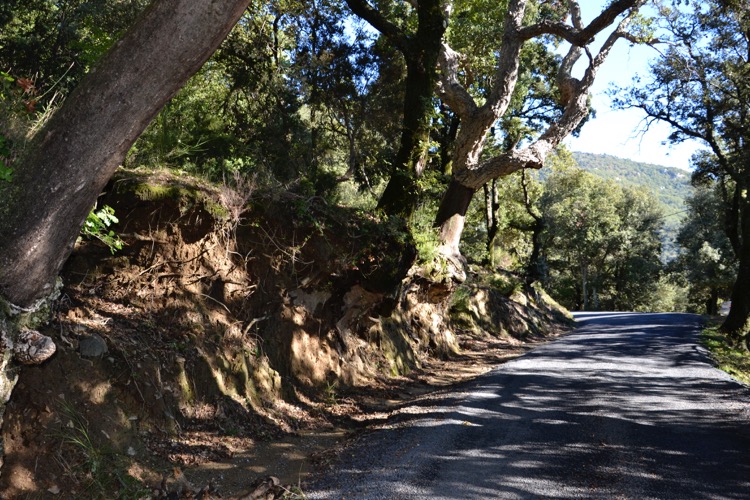
Today, its shady forest, mountain spring and magnificent views make it a peaceful place to walk, eat and escape the summer heat. But these paths once belonged to shepherds, customs officers and smugglers slipping quietly across the border under cover of darkness.
A natural crossing between France and Spain
At an altitude of 938 metres, the Col de l’Ouillat — or Coll de l’Ullat in Catalan — lies among Corsican pines, beech trees and a handful of impressive sequoias.
Before modern roads and border controls, the tracks crossing the Albères provided countless discreet routes between France and Spain. Smuggling became particularly common whenever shortages, taxes or political upheaval made everyday goods cheaper or easier to find on one side of the border.
Tobacco, alcohol, olive oil, food and other goods were carried across the mountains. Smugglers were sometimes known as travailleurs de nuit — night workers — and needed to know exactly where the customs officers were waiting.
According to local tradition, stones and pebbles were arranged in particular patterns to pass coded warnings. Their position or number could tell those following whether customs officers had been seen, where they were hiding and possibly how many were nearby.
Manel, the shepherd who transformed the mountain
At the heart of the story is Emmanuel Coste, better known as Manel.
Born at Saint-Martin de l’Albère in 1822, Manel spent most of his life tending animals in the mountains. He had never attended school and could neither read nor write, but he knew the Albères intimately and developed a deep attachment to their springs, forests and paths.
Rather than simply passing through the landscape, he began reshaping it.
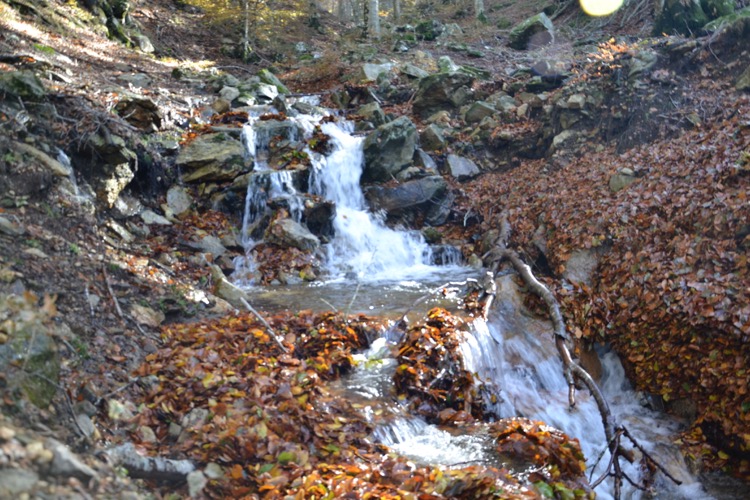
Manel captured natural springs, channelled the water into stone basins and created places where travellers and shepherds could rest. He added stone seats, tables and shelters, sometimes transporting large and extremely heavy stones across the mountain with the help of local men.
He also planted trees around his fountains. Some of the mature trees that shade the col today are said to be part of his legacy.
La Reine des Sources
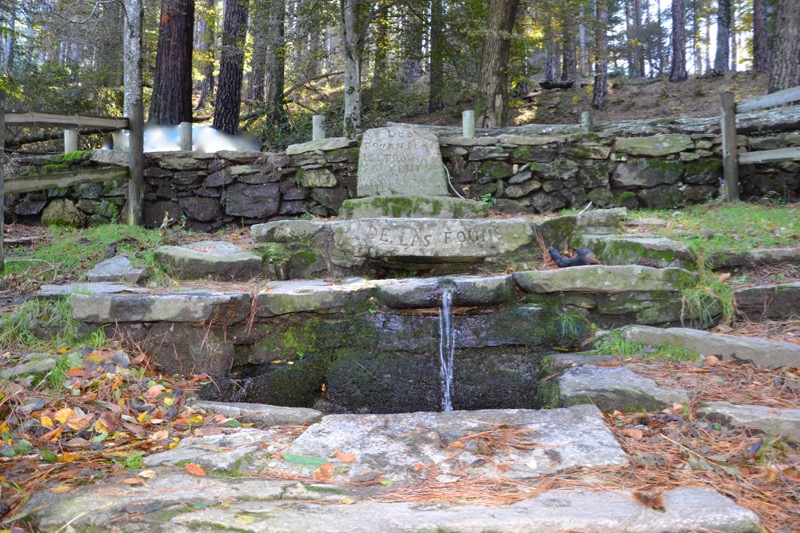
Manel’s best-known creation is the fountain below the Col de l’Ouillat. He began transforming the natural spring in around 1881, naming it La Reyne de las Founs — more commonly written today as La Reina de les Fonts, or “The Queen of the Springs”.
Water emerges from the mountain and flows through a wonderfully eccentric arrangement of rocks, basins and carved stones. Manel imagined the inscriptions himself, then asked the schoolteacher at Saint-Jean-d’Albère to write down the words so that they could be engraved.
One inscription reads:
Les douaniers ici trouvent souvent ce qu’ils cherchent.
“Customs officers often find what they are looking for here.”
Was it a joke, a warning or a mischievous reference to the contraband passing through the mountains? Perhaps all three.
The traditional story says that smugglers later used arrangements of pebbles around the fountain to leave coded information for one another. It is a wonderfully intriguing tale, although the precise code — and how widely it was used — is now difficult to verify.
Manel’s tower on Pic Néoulous
Manel left another remarkable mark at the top of Pic Néoulous, the highest point of the Albères.
In the 1880s, he constructed a four-metre-high pyramid from carefully assembled dry stone. Stones projecting from its sides formed a kind of spiral staircase leading towards the top.
The original tower was later demolished, but a replacement was built in 1964 in memory of the shepherd who had devoted so much of his life to the mountain.
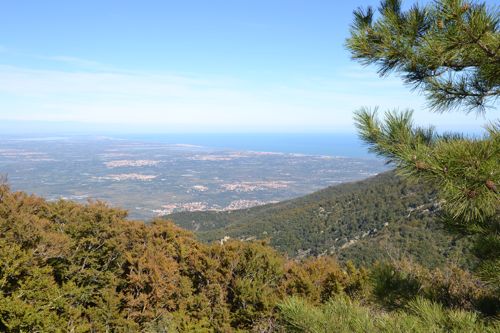
The summit is now also home to large communication masts, which are rather less romantic. Nevertheless, at approximately 1,256 metres, the views can be spectacular: the Roussillon plain and Mediterranean coast on one side, Spanish Catalonia on the other, and Canigó rising inland.
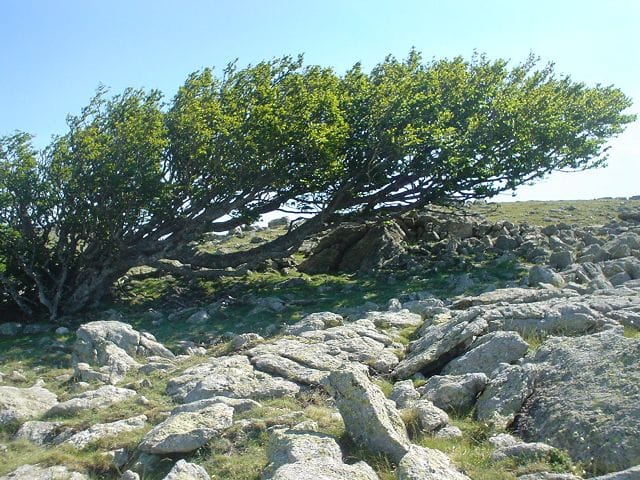
The Catalan name Puig Neulós is thought to refer to a cloudy or mist-covered summit — and it frequently lives up to its name. Even on a fine day below, cloud and strong winds can gather quickly around the top.
Walking from the col to Pic Néoulous
The Col de l’Ouillat makes a convenient starting point for the walk to Pic Néoulous.
The official circular route is approximately 6.1 kilometres, with around 355 metres of ascent. Allow roughly two and a half hours, depending on your pace and how often you stop to admire the view.
From the chalet, where parking is plentiful, follow the yellow-marked path, passing below Roc Fuiros before joining the frontier ridge near Pic des Trois Termes. The route then continues towards the summit and returns through the forest.
It is classed as an intermediate walk. Wear proper footwear, carry water and take a windproof layer: conditions on the exposed ridge can be completely different from those at the col.
For those who prefer something gentler, the fountain, forest and picnic areas can be enjoyed without climbing to the summit.
Practical information
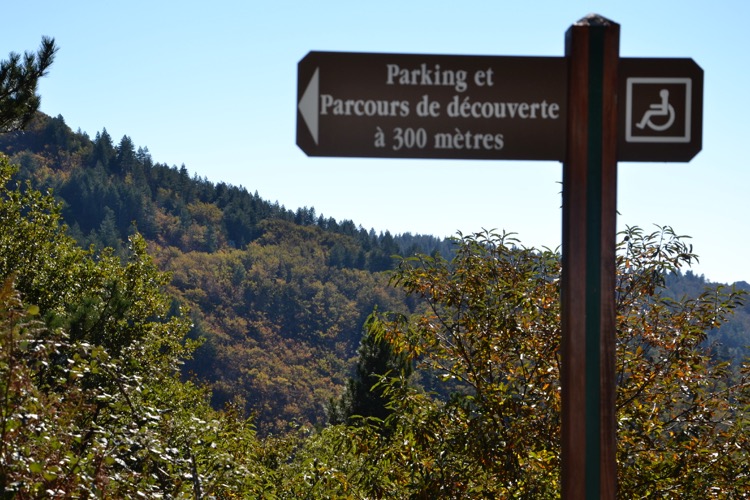
The Col de l’Ouillat is reached by the D71 and D71A from the Le Perthus area. There is parking near the col and the Chalet de l’Albère offers food, drinks and refuge accommodation. Check its opening times before making a special journey.
Picnic and designated barbecue areas are available, but barbecues must never be used when fire restrictions are in force. During periods of high wildfire risk, access to the forest massif may also be restricted or prohibited, so always check the official daily access information before setting out in summer.
And while enjoying the fountain, resist the temptation to rearrange the pebbles. You never know who might be following behind you…
Information checked against Pyrénées Méditerranée Tourist Office, Vallespir Tourisme’s history of Manel and local heritage research into La Reyne de las Founs.