
Planès – The Mystery of Notre-Dame de la Merci
Was it a church? Was it a mosque? Does the curious cloverleaf-shaped Notre-Dame de la Merci at Planès conceal the tomb of Abu-Nezah, the Berber governor of Cerdagne?
Local legend says that in 729 Duke Eudes of Aquitaine married his daughter, Lampégie, to the Berber governor Munuza (also known in later traditions as Abu-Nezah) in an attempt to bring peace to his frontier and end the repeated incursions into Aquitaine.
According to the legend, the Muslim governor of Al-Andalus, acting on behalf of the Umayyad rulers based in Damascus, sent an army to capture and kill Munuza.
Munuza fled from his stronghold at Llívia to the mountains around Planès, where he was captured and killed. The grieving Lampégie is said to have built a tomb for him before being taken to Damascus.
The story has a historical basis too. Munuza was a real Berber governor who rebelled against the Umayyad rulers—but there is no evidence that he was buried at Planès. The association between his death and the church belongs to local tradition rather than established history.
Notre-Dame de la Merci, Planès
Well worth a visit, the church has long been associated with local traditions claiming it could cure fever and sterility.
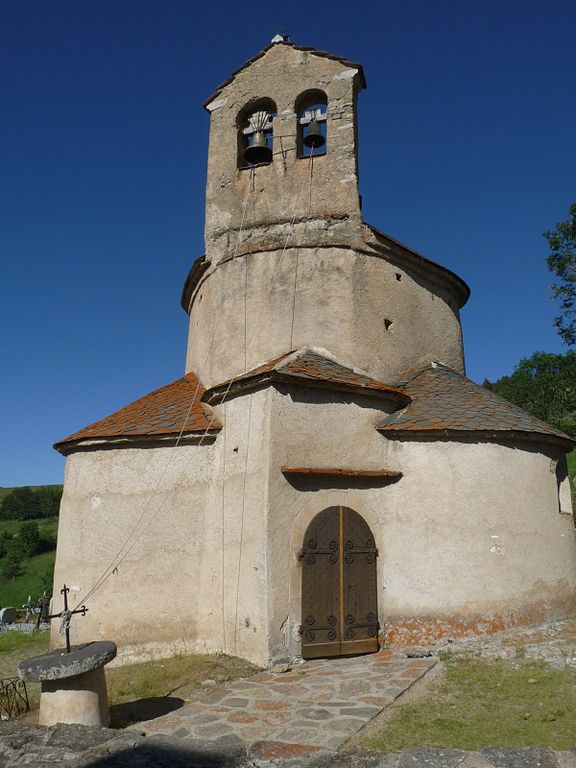
Standing above the small village of Planès in the Têt Valley, Notre-Dame de la Merci is one of the most unusual Romanesque churches in France. Its remarkable plan combines a central circular space with a triangular arrangement of three apses, giving it the appearance of a cloverleaf.
Because of its unusual shape, the church has long been known locally as the Mesquita (“the little mosque”), and earlier writers even suggested that it may once have been a mosque or an Islamic mausoleum. Modern archaeological and architectural research, however, identifies it as an 11th-century Romanesque Christian church, and there is no evidence that it ever served as a mosque or that it contains the tomb of Munuza.
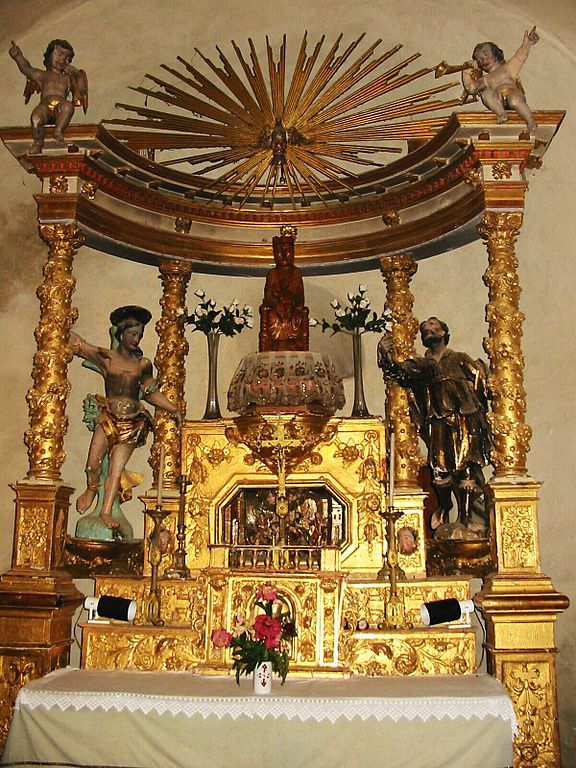
Inside, visitors can admire a fine Romanesque Madonna, adding to the church’s unique character.
The village itself remains delightfully remote. Its small population is scattered across the commune’s fourteen square kilometres at the end of a winding mountain road from Saint-Pierre-dels-Forcats.
The famous Yellow Train (Train Jaune) still stops at Planès on request as it makes its spectacular journey between Villefranche-de-Conflent and Latour-de-Carol via Mont-Louis and Font-Romeu. For most of the year, however, the surrounding countryside remains wonderfully peaceful, with crisp mountain air and relatively few visitors—making Planès an ideal destination for anyone seeking history, architecture and tranquillity in the heart of the eastern Pyrenees.