
THE DEVIL, THE HERMITS AND THE MOUNTAINS
with Tim and Chris Parker
A delightful circular walk combining beautiful countryside, spectacular mountain views, fascinating local history and a little bit of devilish folklore!
Starting near the famous medieval Pont du Diable at Céret, this walk takes us through cherry orchards and quiet countryside to the historic Ermitage de Saint-Ferréol, perched on a hilltop overlooking the Vallespir.

Along the way, we discover stories of medieval engineering, Benedictine monks, religious relics, plague, pilgrimage and a rather remarkable man who spent 44 years as a slave in Constantinople.
There is plenty to enjoy, both on the way up and on arrival where the views across the Pyrenees, the Albères and towards the Mediterranean are quite magnificent.
WALK INFORMATION
- Type: Circular walk, starting and finishing near the Pont du Diable, Céret.
- Walking time: Approximately 2 hours, allowing additional time for sightseeing and exploring the hermitage.
- Distance: Approximately 5–6 km.
- Ascent: Approximately 140–180 metres.
- Difficulty: Moderate. Suitable for reasonably fit walkers.
- Footwear: Walking boots or sturdy walking shoes recommended.
- Map: IGN 1:25,000 Céret – Amélie-les-Bains-Palalda 2449OT.
- Starting altitude: Approximately 144 metres.
- Highest point: Approximately 320 metres.
Please note that the route includes some road walking, uneven tracks, rocky paths and a steep flight of steps on the return. Take particular care when crossing and walking alongside the D615.
THE WALK
1. Starting point – The Pont du Diable

Our walk begins just off the D115, on the road from Le Boulou towards Amélie-les-Bains, close to the junction with the D615 towards Llauro.
Park in the vicinity of the Pont du Diable.
Before setting off, it is well worth crossing the road to have a closer look at this extraordinary medieval bridge.
The Pont du Diable, or Devil’s Bridge, dates from 1321 and is one of the most impressive medieval bridges in the region. Its enormous stone arch spans the River Tech, rising approximately 22 metres above the water. For centuries, this was an important crossing point, linking the Roussillon plain with the Vallespir and the routes towards Spain.
But why is it called the Devil’s Bridge? Local legend has a rather entertaining explanation!
Apparently, the bridge had collapsed twice during construction. The builders were becoming desperate, so the Devil offered to complete it in a single night. There was, naturally, a price to pay. The Devil demanded the soul of the first living creature to cross the bridge at sunrise.
The builders reluctantly agreed.
The Devil worked furiously throughout the night, moving enormous stones and completing the magnificent arch. But the clever engineer had a plan.
Just before sunrise, he sent a black cat across the bridge.
When the cockerel crowed, the Devil realised he had been tricked. In his fury, he forgot to place the final stone.
According to the legend, that stone has never properly stayed in place, no matter how much cement has been used!
The Devil supposedly chased the unfortunate cat as far as Le Boulou.
Whether you believe the story or not, it is a wonderful way to begin our walk!
Cross back over the main road and take a moment to look towards the impressive railway viaduct and the mountains beyond. The different bridges crossing the Tech tell the story of how transport through this valley has developed over the centuries.
Through the cherry orchards
We now set off along the D615, passing underneath the railway bridge.

Take the first road on the right into the residential development. Follow the road around the edge of the lotissement, keeping an eye out for the waymarkers. Do not follow the cycle route towards
Continue towards the countryside, where the route takes us through the cherry orchards.
Céret is particularly famous for its cherries and proudly celebrates the arrival of the early cherry harvest each spring.
The town’s growers have a long-standing reputation for producing some of the first cherries of the French season. Indeed, Céret cherries have traditionally been sent to the president to mark the beginning of the harvest.
In the spring, the orchards are a particularly lovely sight, with blossom covering the trees. Later in the year, the fruit brings splashes of colour to the landscape.
As we climb gently, look ahead to the right. Our destination is already visible on the hilltop: the white buildings of the Ermitage de Saint-Ferréol.
It is a lovely sight and gives us a good idea of where we are heading.
The Ermitage de Saint-Ferréol – A sanctuary with a remarkable history
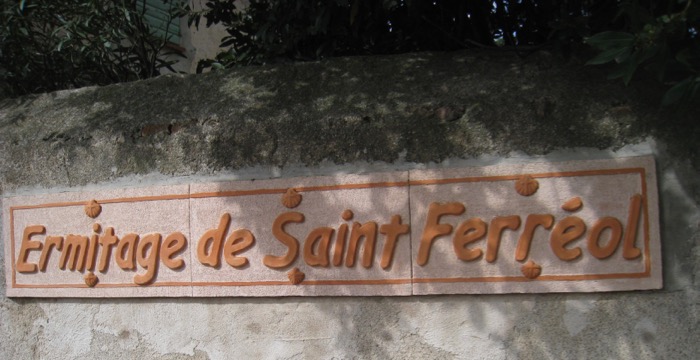
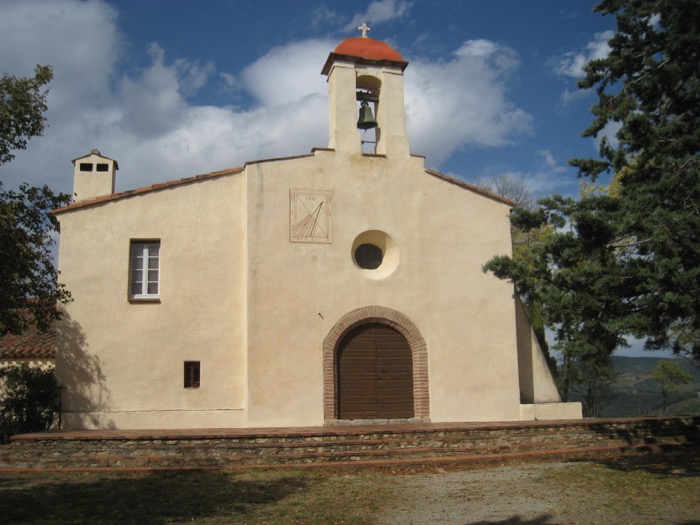
The Ermitage de Saint-Ferréol is the highlight of our walk. Standing at approximately 300 metres above sea level, this peaceful hilltop sanctuary has a fascinating history stretching back to the Middle Ages.
First mentioned in historical records in 1235, it was established by Benedictine monks from the Abbey of Arles-sur-Tech and became an important religious sanctuary, particularly because it housed fragments of the relics of Saint Ferréol and Saint Julien, brought to the region for safekeeping during the troubled period of the Albigensian Crusade. These relics are preserved in beautiful 18th-century reliquaries.
One of the most significant events in the hermitage’s history occurred in 1655, when Céret was struck by a devastating outbreak of plague. The townspeople prayed to Saint Ferréol for protection and, when the epidemic finally ended, attributed their deliverance to the saint’s intervention. In gratitude, a tradition of pilgrimage developed which continues to this day.
Every year on 18 September, Céret celebrates the Festa Major de Saint-Ferréol, when people make their way up the hill in the early hours carrying lamps and lanterns, followed by religious celebrations, traditional Catalan dancing and a gathering of the local community.
There is another remarkable story hidden inside the chapel. Look out for the inscription on the marble holy-water font, which commemorates Laurent Cros, a man born in Ille-sur-Têt who eventually became a hermit here. Dated 1705, the inscription records that he had spent an extraordinary 44 years as a slave in Constantinople. We know little about how he came to be enslaved or how he eventually returned home, but his story is a fascinating reminder of the extraordinary lives connected with this peaceful sanctuary.
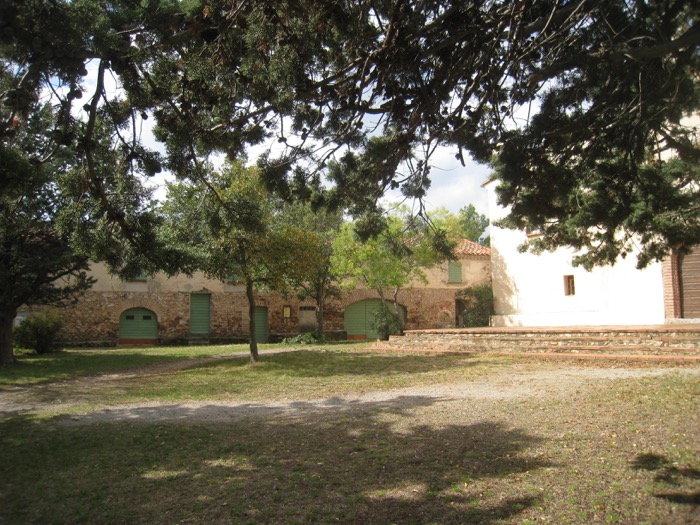
The chapel itself has undergone several changes over the centuries. By 1780, the original medieval building had fallen into disrepair, and a larger chapel was subsequently constructed with financial support from two prominent local families, the Ribas and the Companyo. In 1975, a fire destroyed the adjoining buildings, although the chapel survived, and the damaged outbuildings were later restored. More recently, important restoration work has helped preserve the chapel’s historic retables and statues. If the chapel is open, it is well worth looking inside at its religious artwork, sculptures and furnishings.
Before leaving, don’t miss the sundial outside, a replacement of the original installed in 2004. It bears the Latin inscription ULTIMAM TIME, meaning “Fear the last hour” – a rather thought-provoking message for a place devoted to faith, prayer and reflection!
Enjoy the views
The setting of the hermitage is quite spectacular, and this is a wonderful place to stop, rest and enjoy the scenery. Take time to look around and identify the surrounding landscape.
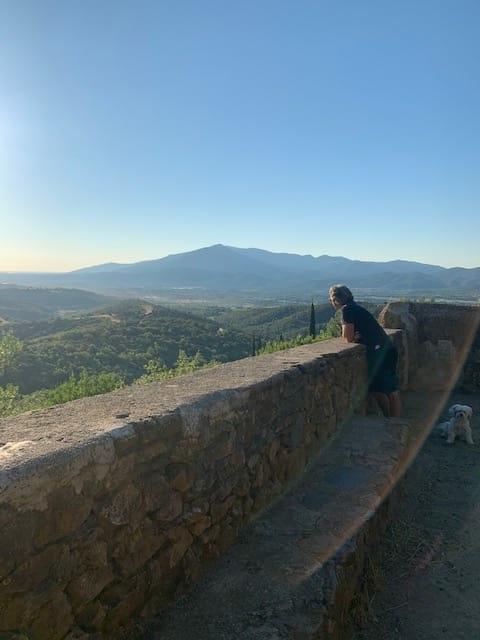
To the north-west stands the magnificent Mount Canigou, one of the most recognisable and symbolic mountains in Catalonia.
To the south and east are the Albères, forming the natural mountain frontier between France and Spain.
Below us lies the fertile valley of the River Tech, with Céret and its surrounding countryside.
On a clear day, the views extend towards the Mediterranean coast.
The Canigou, in particular, has a special place in Catalan culture. It has inspired poets, writers and artists for generations and is regarded by many as a symbol of Catalan identity. It is easy to understand why the monks chose this peaceful and commanding location. Allow yourself some time here in this spiritual oasis maybe with a picnic. There is no need to hurry!

The return journey – Roc Blanc and the countryside
After enjoying the hermitage, we continue our circular walk.
Take the path behind the buildings, descending towards the lane and eventually reaching the D615. The route then crosses the road and continues uphill along a marked path, reaching approximately 320 metres before joining a double track.
Follow the track as it descends towards the road.
There is an alternative here for anyone wishing to shorten the walk: rather than taking this additional section, it is possible to follow the road down to the next meeting point.
Otherwise, continue along the D615 for approximately ten minutes until reaching the waymarker for Roc Blanc.
Turn left onto the double track for a short distance, then take the right-hand fork uphill. The track passes a property and continues past a number of scattered houses.
As we make our way down the hillside, look back occasionally. The Ermitage de Saint-Ferréol remains visible on the hill to our left for quite some distance., a prominent sanctuary in the surrounding landscape.
Eventually, a narrower, rocky path leaves the main track on the right.
Follow this path as it descends towards the residential area, where we reach a steep flight of concrete steps. Take care here, particularly if the ground is wet.
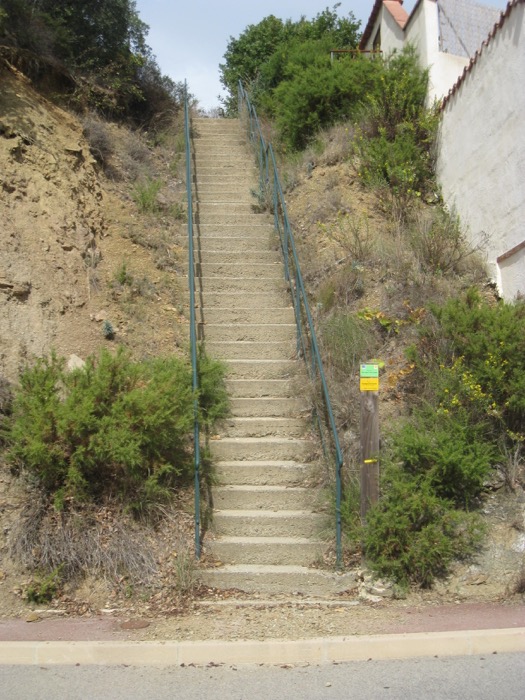
At the bottom, turn right and then left to join the D615, which brings us back to our starting point near the Pont du Diable.
And so our circular walk comes to an end!
A LITTLE MORE TO EXPLORE
If you have time, why not combine this walk with a visit to Céret, one of the most charming towns in the Vallespir, with leafy squares, narrow streets, attractive cafés and a fascinating artistic history.
The town became an important meeting place for artists in the early 20th century. Pablo Picasso, Georges Braque and other influential artists spent time here, helping to establish Céret as an important centre of modern art.
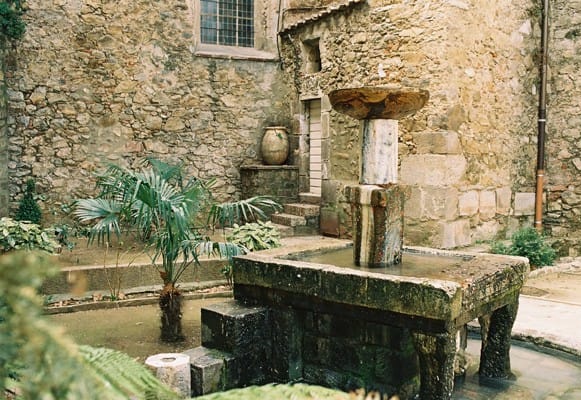
The Musée d’Art Moderne is well worth a visit, with an impressive collection of modern and contemporary works and you can also enjoy a leisurely lunch dinner or a coffee/beer in one of the town’s many cafés and restaurants – a perfect end to a day combining walking, history, culture and wonderful scenery.
A WALK THROUGH HISTORY, LEGEND AND LANDSCAPE
From the medieval ingenuity of the Pont du Diable to the peaceful sanctuary of Saint-Ferréol, this walk offers much more than a pleasant climb into the hills. It is a chance to discover the stories, traditions and history that make this corner of the Vallespir so special.
And perhaps, as you cross the Devil’s Bridge on your way home, you might spare a thought for that unfortunate black cat!
The feast of St Ferreol is because St Ferreol’s birthday was on the 18th December and the small order of nuns who are missionaries usually return to the Ermitage each year to Celebrate the saints birthday.
Thank you Jeanne. I know you live up that way. Any other interesting snippets to add?