
Three of the “five sons of Carcassonne.”
There are castles and then there are castles.
Perched impossibly high on rocky peaks, overlooking the vineyards, valleys and mountains of the Aude and Pyrénées-Orientales, Quéribus, Peyrepertuse and Puilaurens are three of the fortresses traditionally known as the “Five Sons of Carcassonne”.
And there is an extra reason to visit them in 2026: the Royal Capetian Fortresses of Languedoc have just been inscribed on the UNESCO World Heritage List. The new World Heritage site comprises eight fortresses, including Carcassonne, Aguilar, Lastours, Montségur, Peyrepertuse, Puilaurens, Quéribus and Termes. They formed part of the formidable defensive system established by the French Crown in the 13th and 14th centuries following the Albigensian Crusade.
The story is a complicated one of Cathars, crusades, shifting frontiers and royal power. These mountain fortresses became part of the French Crown’s defensive line facing Aragon, occupying strategic rocky heights that were, frankly, so spectacular that you might suspect the medieval military architects were showing off.
It is possible to visit all three in a very full day but, to be honest, they warrant considerably longer. Each has its own character and, once you start climbing, you will probably want time to stop occasionally and admire the view — or recover from the climb.
Perched on their unbelievable rocky outcrops, Quéribus and Peyrepertuse dominate the beautiful rolling vineyards around Maury and Cucugnan, while Puilaurens looks down over the Boulzane valley.
And so, in no particular order of difficulty to reach, here they are.
Château de Quéribus
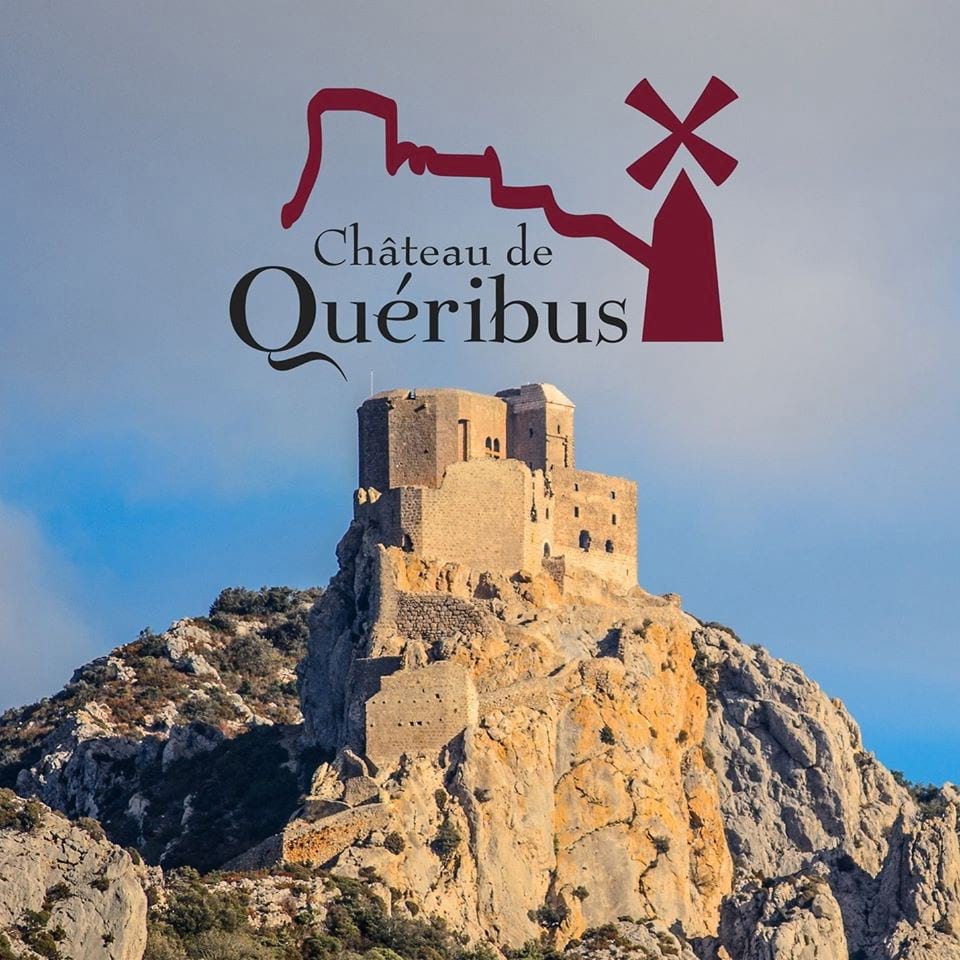
From Estagel, take the N117 towards Maury and follow the signs for Cucugnan.
As you climb the Grau de Maury towards the Aude, you will see Château de Quéribus on the right, built on its extraordinary 728-metre-high rocky pinnacle. It is difficult to imagine a more dramatic defensive position.
Quéribus was one of the last strongholds associated with the Cathar resistance. It was taken by the forces of Louis IX in 1255 and subsequently became part of the royal defensive system, guarding the strategic pass of the Grau de Maury. A garrison of twenty men was established there — which seems remarkably few until you see the place for yourself and realise that the rock, the precipices and the ingenious defences were doing most of the work.
From its lofty perch the castle commands extraordinary views across the Corbières, Fenouillèdes and the plains of Roussillon.
Today, the ruined fortress remains a monument to the dramatic events that shaped this turbulent border country — and a wonderful place to stand in the wind and wonder how on earth anyone thought climbing up there in medieval armour was a sensible career choice.
Château de Peyrepertuse
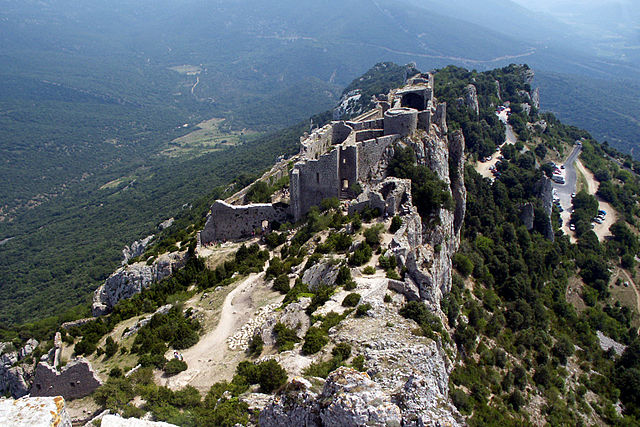
From Quéribus, Château de Peyrepertuse is easily visible: an amazing fortress seeming to grow straight out of the sheer rock on the skyline.
At around 800 metres above sea level, it is one of the most spectacular of all the Cathar-country fortresses. The site itself was occupied long before the medieval castle appeared, with evidence of human presence going back to prehistoric and Gallo-Roman times.
Peyrepertuse became a royal fortress in the 13th century. Following the Treaty of Corbeil in 1258, it formed part of the French Crown’s new defensive frontier against Aragon. Louis IX had major works carried out, including the extraordinary staircase carved into the rock in 1242 and the upper fortress of San Jordi, built around 1250–51.
And what a fortress.
From the ticket office, a short, shady walk through scented box brings you to the entrance. Then the fun — or the hard work — begins.
The steep Escalier de Saint-Louis, cut directly into the rock, leads towards the upper fortress and the chapel of Saint-Jordi. From there the views are extraordinary: Quéribus, Forca Real, the surrounding peaks and valleys, and the distant landscapes of the Aude and Roussillon all spread out below. It formed an important part of the Cathar defences and a secret passage ending in a movable ladder afforded vital access. It can still be found, the last part of the climb a vertiginous cliff “voie escalade”.
History oozes from the ancient walls and, in spring, cowslips and fritillaries flower between the fallen stones.
The fortress remained strategically important for centuries. After the Treaty of the Pyrenees in 1659 moved the French-Spanish frontier further south, it lost much of its military importance but retained a small royal garrison until the early years of the French Revolution, when it was finally abandoned.
It is now a wonderfully atmospheric place to explore — although I suspect Louis IX would have been less interested in the wildflowers than in whether the enemy could be seen approaching from the next mountain.
Château de Puilaurens
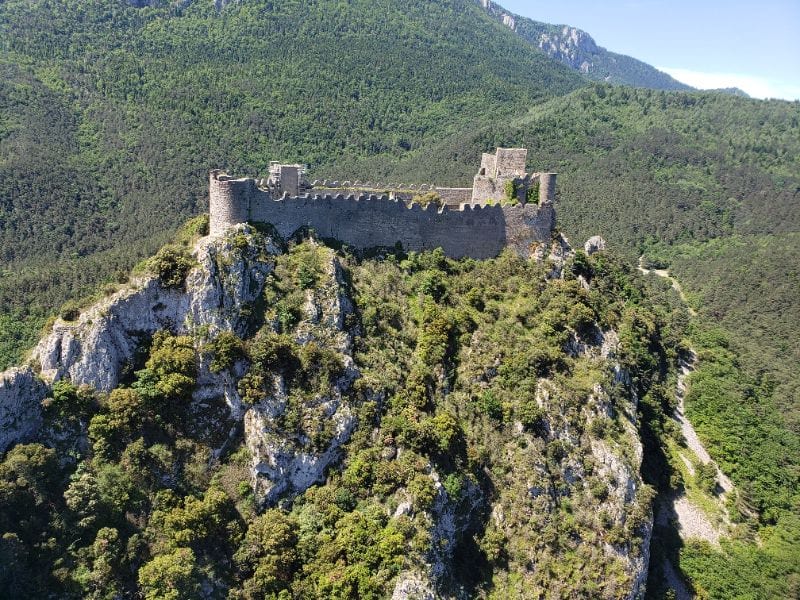
Puilaurens is rather different.
The castle rises high above the village and the valley of the Boulzane, looking for all the world like something from a particularly ambitious medieval fairy tale.
The area has been inhabited since prehistoric times and the mountain itself, once known as Mont Ardu, was already marked on a medieval map. Puilaurens provided refuge for Cathars in the 1240s and subsequently became another important link in the royal defensive chain along the southern frontier.
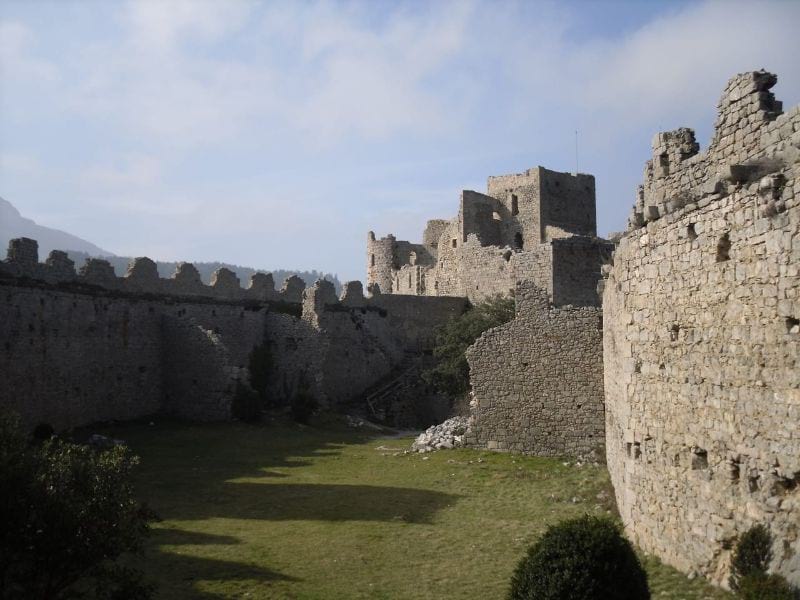
The approach is relatively gentle by castle standards: a roughly twenty-minute shaded walk from the car park brings you to the fortress.
And then you find yourself in another world.
The Square Tower dates from the period of the Crusade against the Cathars, while the castle was strengthened and adapted over the centuries as its role changed. After the frontier moved south, its military importance declined and eventually the castle fell into disrepair.
Today it is cared for and fascinating to explore, with the ruins offering wonderful views over the village, the 1904 railway viaduct and the Forest of Fanges.
There is also a lovely story attached to the so-called White Lady Tower. According to local tradition, Blanche de Bourbon is said to have stayed here on her journey south to her disastrous marriage to Peter of Castile.
Blanche was only fourteen when she married Peter in 1353. The marriage lasted just three days before he abandoned her for Maria de Padilla, and Blanche was eventually imprisoned and, at the age of twenty-two, murdered.
The tower is said to contain a narrow duct through the wall that acts rather like a speaking tube.
One can only hope, if the story is true, that poor Blanche made good use of it — and, while she was at it, enjoyed the marvellous views from the battlements.
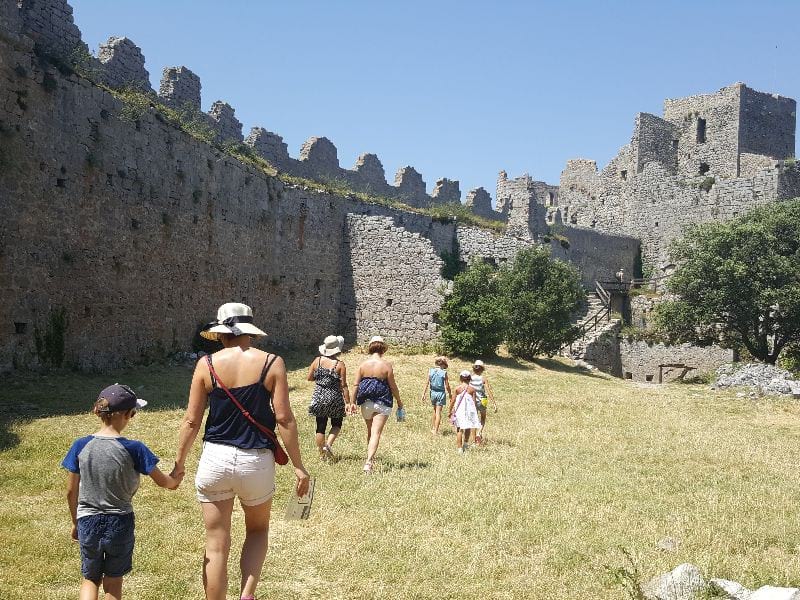
And that, really, is the pleasure of these extraordinary old castles.
They are not polished palaces. They are battered, windswept, sometimes vertiginous ruins clinging to the most improbable bits of mountain. But stand on the battlements of Quéribus, look across at Peyrepertuse, or gaze down from Puilaurens over the forests and valleys, and suddenly the centuries between us and the people who lived here seem to disappear.
Three castles, one extraordinary landscape, and a very large slice of history.
And now, officially, World Heritage too.
[…] A day out in Cathar Country Three fantastic medieval castles, three of the “five sons of Carcassonne.” In 1258, with the Treaty of Corbeil, Quéribus, Peyrepertuse and Puilaurens were right on the frontier between France… […]