

- This event has passed.
Fête de l’Ours – Bear Festival, Saint-Laurent-de-Cerdans
1st March
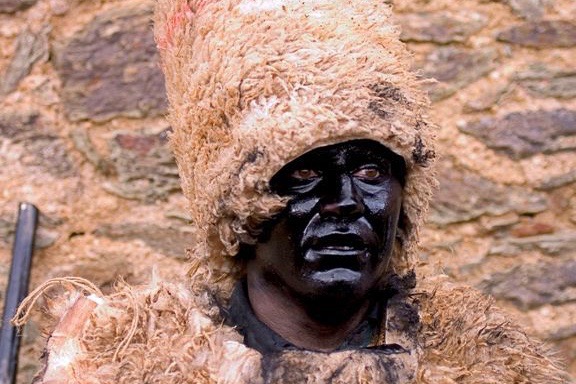
Bear Festival and Carnival
Where and when?
Bear Festivals take place each year in late winter (usually February) in several villages of the Vallespir, notably Saint-Laurent-de-Cerdans, Prats-de-Mollo-la-Preste and Arles-sur-Tech, each with its own variations. The festivals are officially recognised as part of France’s cultural heritage, underlining their cultural importance.
Bear Festival, Saint-Laurent-de-Cerdans
The Saint Laurent bearfest is based around age-old traditions, pre-Christian rituals, linked to the cycle of nature, fertility and the transition from winter to spring — the bear symbolising both danger and renewal. This is not a staged show but a living, community-led tradition, with entire villages involved and generations passing down the roles, poems and costumes as villagers dress up as bears and the capture is purely symbolic.
Expect noise, smoke, crowds and close contact. Old clothes are advised and expect a day that may be chaotic, playful and intentionally unsettling — and all part of the fun
The story
In the past, the young men of the mountain villages of the Pyrénées would attempt to capture a bear at this time of year, in order to prove their bravery! The time of year was well chosen, the bear being weakened by long months of hibernation.
Until 1992, the costume was made out of goat skins sewn together, but now a real bear skin is imported from Canada and the old goat skin bear outfit is on display at the Saint Laurent Museum.
An even earlier example of this type of costume can be seen at the Casa Pairal in Perpignan.
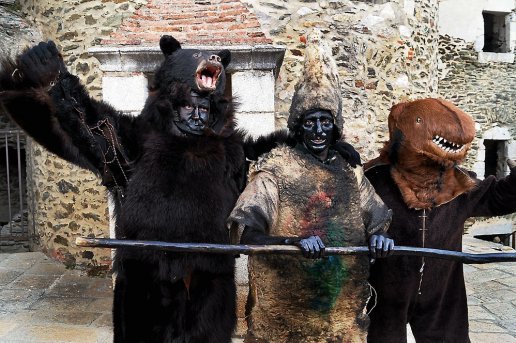
Other strange things
Watch out during the procession for the ‘monaca‘ a strange monster with two bodies, two heads and four pairs of legs, who represents the end of winter and the arrival of spring and terrorises young girls and children in the streets.
Keep an eye out also for the ‘escalfador‘, a copper bowl in which pig’s hair is burnt, causing a very unpleasant smell. This is carried by two young people disguised as old people whose aim is to quietly slip the bowl under the skirts of the young girls and women!
 The Hunt
The bear comes out of his cave, abducts a young girl and carries her off to the forest. The whole village joins in the hunt to capture the bear.
The ‘meneur’ or leader drags the bear through the street on a chain reciting the Catalan poem ‘La Predica de l’Os’ which describes how bad the bear is, and of course, how brave the hunter is.
The bear dances to cobla music, tries to escape – the macho meneur wins the struggle, takes him to the town square and shaves him.
The bear ‘dies’, lying on the ground for a short time, before leaping up again, this time with a human face. He is now allowed to choose a young lady from the crowd to finish off the event with the ritual dance.
The Bear Festival Today
Today, the Bear Festival remains one of the most powerful and authentic winter traditions in the Pyrénées-Orientales. Part carnival, part ritual, and part controlled chaos, it marks the end of winter and the return of life, reminding onlookers that some traditions are meant to be experienced rather than explained.