
Made up of distinctive yellow and red carriages — the Catalan colours known as “sang et or” (blood and gold) — the Petit Train Jaune has been climbing through the Pyrenees for more than a century. Built in the early 1900s to open up isolated mountain communities, the railway connected the high plateaux of Cerdagne with the rest of the Pyrénées-Orientales.
Today, the line runs 63 km between Villefranche-de-Conflent and Latour-de-Carol – Enveitg, serving around 22 stations along the way.
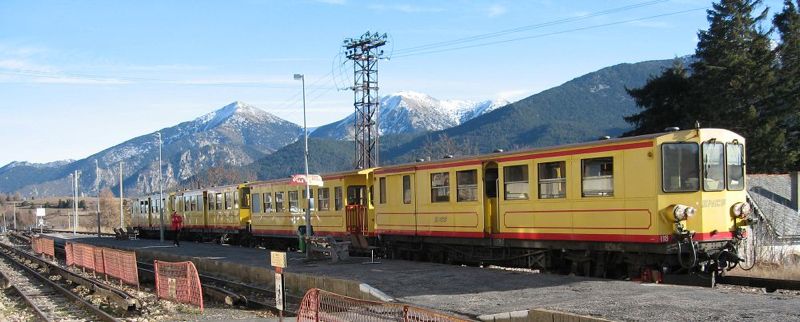
A Record-Breaking Mountain Railway
The Train Jaune climbs from about 427 m in Villefranche-de-Conflent to over 1,230 m at Latour-de-Carol, reaching its highest point at Bolquère–Eyne station (1,593 m) — the highest station on the SNCF network.
Expect breathtaking views: deep gorges, dramatic mountain peaks, and vast plateaux unfold as the train winds through the Parc naturel régional des Pyrénées catalane
Engineering Marvels
Constructing the railway required around 650 engineering structures, including 19 tunnels and dozens of bridges and viaducts.
Two masterpieces stand out. The Viaduc Séjourné is a granite structure soaring about 65 m above the Têt valley. ThePont Gisclard rises roughly 80 m above a precipice, it was the first suspension bridge in the world designed for railway traffic.
The route is steep, with gradients reaching about 6%, which explains the need for sophisticated engineering.
Because of the steep gradients — some reaching around 6% — the Train Jaune relies on several complementary braking systems. After a tragic test accident in 1909 caused by braking failure, additional electromagnetic emergency brakes were installed, helping establish the strong safety standards the railway maintains today
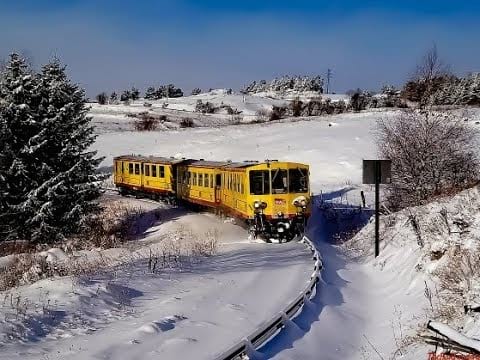
Power from the Mountains
One of the line’s most remarkable features is its energy source. The Train Jaune is the only railway in France powered by its own hydroelectric system, built specifically for the line in 1903. Electricity is supplied via a third rail carrying 850 volts, rather than overhead cables — another unusual characteristic for a mountain railway. It was a visionary idea as, at the time of construction, electrifying a high-altitude railway using hydroelectric power was considered revolutionary engineering.
A Line Born from Ambition
The project was authorised in 1903, and the first section opened in 1910 between Villefranche and Mont-Louis. In 1911 it was extended to Bourg-Madame and in 1927 the final stage to Latour-de-Carol was completed. The railway’s mission was simple but vital: to “désenclaver” — open up — the remote mountain region and connect it to the wider world.
Visit Dorres between Bourg Madame and Envieg (take the D618 then the D10 to Dorres) to see a granite stone cutters museum, showing how the granite was cut for use in the tracks of the Train Jaune, the Barrage of Bouillouses, and the Basilique of Lourdes.
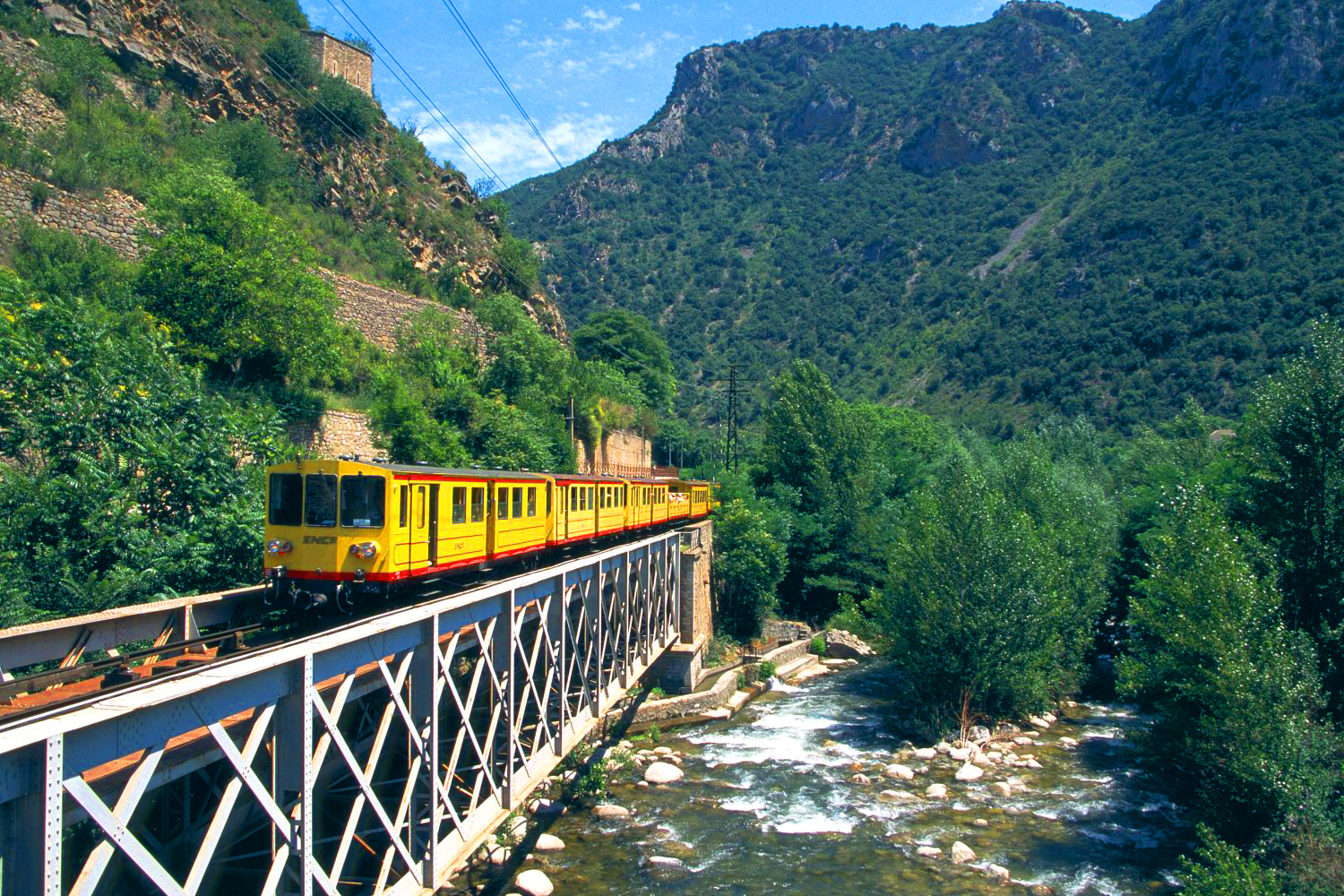
The Journey Today
Operating year-round, the train remains both a practical service and a major tourist attraction. In summer, open-air carriages allow passengers to experience the scenery like a moving panoramic film.
The full journey takes about 3 hours without stops, though many travellers choose to hop off and explore historic towns, hot springs, hiking routes, and UNESCO-listed Vauban fortifications along the route.
A dramatic beginning
During a trial run in 1909, a tragic accident caused by icy rails claimed several lives — including engineer Albert Gisclard — but the line went on to become one of the safest mountain railways.
Did You Know?
- Bolquère–Eyne is the highest railway station in France.
- The line climbs roughly 1,200 metres in elevation during its journey.
- Around 400,000 passengers ride the train each year.
- The train is affectionately nicknamed “Le Canari” (The Canary) by locals.
A Catalan Icon
Today, the train is more than just transport – it is a Catalan icon. Over 110 years later, the Petit Train Jaune has remained a powerful symbol of Catalan identity and mountain heritage. What began as a lifeline for remote villages is now one of the most scenic rail journeys in France — a slow, unforgettable way to experience the Pyrenees.
Because of the steep gradients — some reaching around 6% — the Train Jaune relies on several complementary braking systems. After a tragic test accident in 1909 caused by braking failure, additional electromagnetic emergency brakes were installed, helping establish the strong safety standards the railway maintains today.
The petit train jaune faced uncertain times back in 2016, when it was struck by financial troubles and significant track damage. Fortunately for the region, the line was saved and the emblematic yellow carriages continue to climb and descend the beautiful Pyrénées, helped by strong regional support and major investment, including millions spent on infrastructure and rolling-stock overhaul to extend its service life and improve safety.
The line is single-track, so trains pass each other at designated stations under controlled signalling. (Olette, Fontpédrouse, Mont-Louis, Odeillo, Saillagouse, Bourg-Madame) so the driver has to check by radio with the control centre in Villefranche and obtain permission to leave each station!
The line leaves Villefranche-de-Conflent, goes up through the Tet gorges to Mont Louis and crosses over the col de la Perche into Cerdagne. It passes Font-Romeu, descends towards Saillagouse, Osséja, Bourg-Madame, Ur, and finishes in Latour-de-Carol where passengers can link up with the “Transpyrénéen” (Paris-Toulouse-Barcelone). It goes through 19 tunnels and over 2 viaducts:
Click here for timetables and loads more info about the petit train jaune.
Has anyone travelled on it in winter? The photos in the snow look wonderful, but do you need to go dressed for a long ride on a ski-lift?
BTW, thanks for all the practical advice in the link.
Tickets can be purchased on the Internet on the sncf website: https://www.ter.sncf.com/occitanie/loisirs/patrimoine-culture/train-jaune, at station counters or from ticket inspectors for stations with optional stops. In 14 of the 21 stations, the train only stops if you ask for it.
Hi I am trying to book tickets online. is there a link I should use
Thanks