
Until 14 March, visitors to Argelès-sur-Mer have the opportunity to encounter one of the most moving artistic testimonies of twentieth-century exile. The Argelès Camp Memorial is presenting twenty restored watercolours by the Catalan painter, illustrator and poster artist Lluís Vidal Molné.
The works, on loan from the Mémorial du Camp de Rivesaltes, offer an intimate and rare vision of life inside the internment camp at Argelès in 1939 — seen not in stark monochrome, but in colour.
An artist forced across the Pyrenees
Born in Barcelona in 1907, Vidal Molné was thirty-two when war uprooted his life. At the beginning of 1939, as Franco’s forces secured victory in the Spanish Civil War, hundreds of thousands of civilians and soldiers fled north across the Pyrenees in what became known as La Retirada.
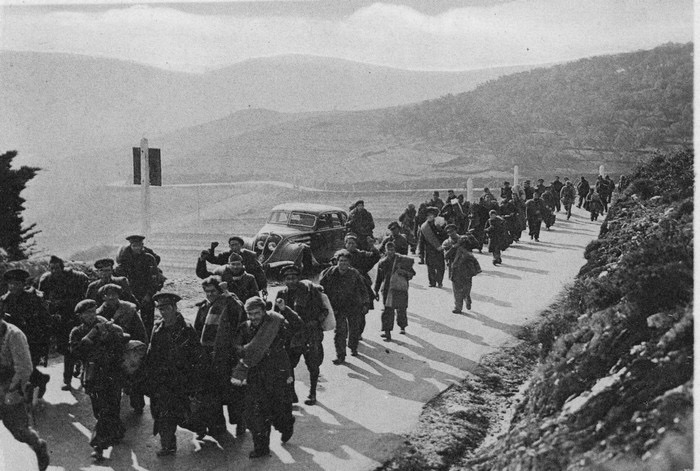
Within a matter of weeks, nearly half a million people crossed into France — one of the largest sudden refugee movements in modern European history. French authorities, overwhelmed and wary of the political character of the refugees, confined many of them in hastily established camps along the Mediterranean coast.
Among them was Vidal Molné.
A camp built on sand
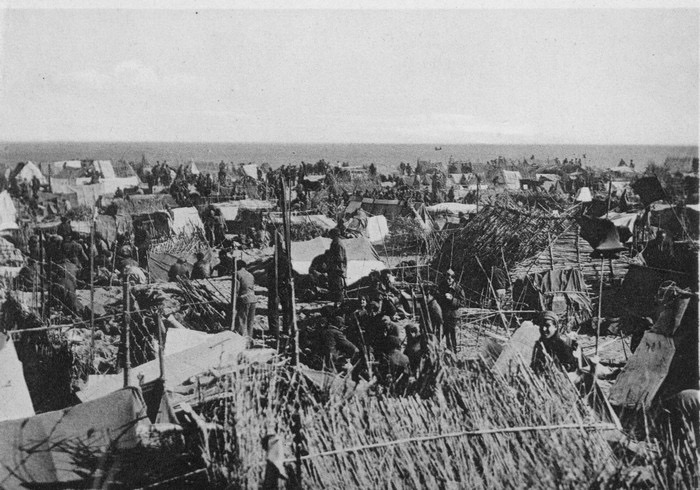
He was interned at the Camp d’Argelès-sur-Mer — a place that, at first, was scarcely a camp at all. There were no barracks when detainees arrived, only barbed wire stretched across an exposed stretch of beach.
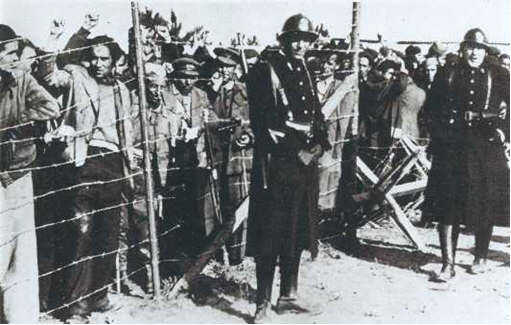
Refugees slept directly on the sand. Some dug shallow pits for shelter; others erected fragile windbreaks from blankets or scraps of wood. Winter storms swept across the shoreline. Food was limited, sanitation poor, and exposure constant.
It was in this stark environment — with almost no materials and little protection — that Vidal Molné painted.
Art as survival
Like many Spanish Republican artists in exile, he continued to create despite extreme scarcity. Paper, brushes and pigments were difficult to obtain; tools were improvised; scraps reused. In some camps, artworks could even be exchanged for food.
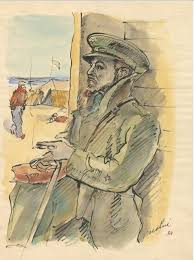
Yet creativity persisted. Across the internment camps, detainees organised improvised classes, theatrical performances and exhibitions. Artistic expression became a means of preserving dignity, identity and memory.
The survival of Vidal Molné’s watercolours is therefore remarkable. These were not studio works. They were created in confinement, under conditions that barely allowed for survival.
A rare vision — the camp in colour
Most visual records of the Retirada camps consist of black-and-white photographs. Vidal Molné’s watercolours offer something entirely different. They restore atmosphere — the Mediterranean light, pale sand, muted clothing, distant sea and sky.
His paintings do not erase hardship. Barbed wire and confinement remain present. But colour brings back the texture of lived experience — daily routines, human presence, fleeting moments of calm. The camp becomes a place inhabited by people rather than a distant symbol of suffering.
For historians, such works are not merely artistic interpretations but emotional and spatial documents — testimony shaped through perception rather than machinery.
A wider history of exile
For many refugees, Argelès was only the beginning. Thousands were transferred to other camps across southern France. Some later joined the French Resistance during the Second World War; others emigrated to North Africa or Latin America. Spanish Republican soldiers would even help liberate Paris in 1944.
Exile did not end political engagement — it reshaped it.
The small memorial that preserves a vast history
The exhibition is housed in the Mémorial du Camp d’Argelès-sur-Mer, a modest yet deeply significant museum in the town itself. Though small in scale, it carries immense historical weight: this is one of the principal sites dedicated to preserving the memory of the Spanish Republican refugees interned on the beaches of Argelès in 1939.
Reopened in 2017 after extensive work by local historians and the municipality, the Memorial combines a permanent historical exhibition with archival documents, photographs, films, testimonies and works of art. Temporary exhibitions — such as the presentation of Vidal Molné’s watercolours — bring new perspectives to this shared history.
What makes the Memorial especially powerful is its relationship to place. Visitors are not far from where the camp once stood. A memory trail leads through the landscape itself, marking the former boundaries of the camp and guiding visitors to commemorative sites such as the Spanish cemetery and memorial markers along the shoreline. The terrain becomes part of the museum — history anchored in sand, wind and sea.
Despite its modest size, the Memorial plays a crucial role in preserving a history that for decades received little public attention. Today it connects local geography with transnational memory, reminding visitors that exile unfolded not in abstraction, but here — on this very coast.
Remembering the Retirada today
The exhibition forms part of the commemorative programme “Caminos, camins, chemins de la Retirada”, organised by FFREEE, which works to preserve the memory of Spanish Republican exile and transmit it to new generations.
In southern France — especially here in the Pyrénées-Orientales — the legacy of 1939 remains deeply woven into regional identity. Many families descend from those who crossed the mountains that winter. Annual remembrance walks retrace the routes of escape, turning the landscape itself into a living archive.
Why these paintings still matter
Vidal Molné’s watercolours are historical records, but they are also acts of endurance. They reveal how artistic expression persists in confinement, how colour can restore human presence to places of suffering, and how personal vision can preserve collective memory.
More than eighty-five years later, the colours of Argelès still speak — of displacement, resilience and the enduring power of remembrance.