
Whatever Happened to the Macho Frenchman?
For generations, the Frenchman has enjoyed a rather enviable reputation.

Sophisticated. Seductive. Mysterious. A little bit dangerous.
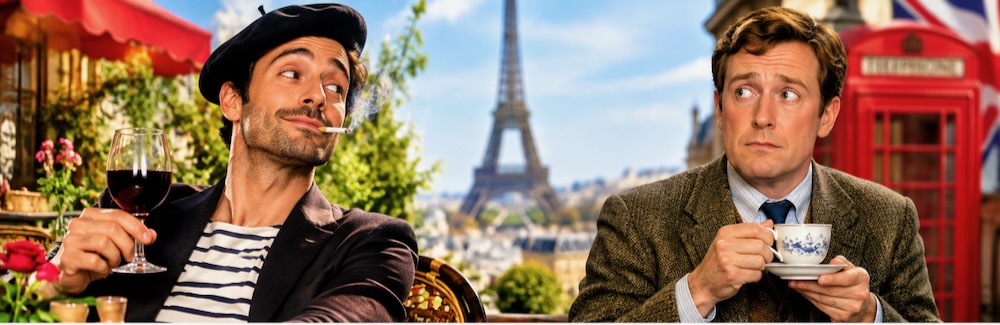
The sort of man who could light a cigarette, pour you a glass of wine, look deeply into your eyes and tell you that you were beautiful — all before lunch, and despite you being in the middle of loading up the dish washer.
The British man, meanwhile, was expected to maintain a respectful distance, apologise if his elbow accidentally touched yours and eventually ask, after several weeks of careful consideration, whether you might perhaps like a cup of tea.
But the Frenchman may be losing his crown as Europe’s greatest lover.

The Frenchman: naturally macho?
The typical French man has always had a swagger, a smooth confidence, a tradition of séduction: the art of pursuing, charming and generally making himself irresistible to the opposite sex.
And although the Frenchman may be becoming more modern, the old-fashioned idea of masculinity hasn’t disappeared completely.
A 2024 *Ipsos survey found that one in five people in France still thought that a man who stays at home to look after his children isn’t really “a man”. Even more intriguingly, 39% thought that men are now being asked too much in the name of gender equality — almost double the figure recorded in 2019.
So the average Frenchman may have discovered feminism. He’s just not entirely sure what to do with it.
And then came #MeToo
The #MeToo movement changed the conversation everywhere, including France. Suddenly, the old rules of flirtation were being examined rather more carefully. When does flirting stop being flattering? When does persistence become harassment? When does a compliment become uncomfortable?
In France, the debate was particularly interesting because of the traditional importance placed on séduction and the rather old-fashioned French concept of galanterie.
During the early years of Emmanuel Macron’s presidency, the government also took a tougher line on street harassment, including wolf-whistling, as part of a wider attempt to tackle what was described as France’s “macho culture”.
The latest research suggests that French men are thinking more about consent, receptiveness and how their behaviour might be perceived. Among people who had been single and dating during the previous eight years, 65% of men said they thought more carefully about how they approached someone they liked. Almost half said they worried about making a sexist remark or behaving in a sexist way.
The old French séducteur isn’t necessarily disappearing.
He may just have grown up a little.
Compliment or just plain rude?
So when does a compliment become a threat? Is it just a French thing?
Well, or course not….but in an admittedly rather *old poll on the rudest people in the world, guess who came out on top? (no pun intended). Yes. French men!
They also come first, along with the Italians, as top of the cheaters, although this survey was onducted for Gleeden, a dating site specialising in extra-marital encounters, so perhaps we shouldn’t be entirely astonished by the result.
Still, it does rather undermine the old romantic image.
Historically, French culture has tended to be more tolerant of infidelity than Anglo-Saxon countries, and French men are traditionally very confident in their own sex appeal- but the-times-they-are-a-changing!
According to another (also admittedly old) survey by *GoEuro, the online travel planner, British men have overtaken the traditionally sexy Frenchman for charm, gentlemanly behaviour and general ‘lady-appeal’.
Galanterie?
In the 2024 *IFOP survey, 82% of French people still said they did not consider galanterie sexist. Opening a door, offering his coat on a cold day, pulling out your chair…..
As a woman who has reached “a certain age”, I rather like the occasional reminder that I haven’t become completely invisible.
I don’t necessarily want to be followed down the street by a man shouting compliments, (but please feel free) but if someone wants to tell me I look nice I’m not going to call the police.
There must surely be a middle ground between sexual harassment and making a woman feel that she doesn’t exist!
And what about seduction?
The Frenchman has always had the international reputation. of being exceptionally good at this but it seems that the rest of Europe has been catching up.
One large *European survey found that Italian men had overtaken the French in the international sex-appeal stakes, with British and Spanish men also scoring highly.
Imagine spending centuries cultivating a reputation as the world’s great lovers only to discover that the Italians have stolen your job.
So is the Frenchman having to reinvent himself? Still confident, still charming but perhaps a little less convinced that being male automatically makes him irresistible.
We thought we should give some French men the opportunity to defend themselves.
After all, if anyone can talk their way out of a difficult situation, it should surely be the French.
 Olivier, Maureillas (and coincidentally the author’s husband!)
Je ne pense pas que les Français soient plus machos que les autres mais dans mon cas cela n’aurait pas marché car je suis marié à une machotte.
Useful vocab
cela n’aurait pas marché — that wouldn’t have worked
car — because
machotte — a made-up feminine version of macho

Axel, Maureillas
Certes, ils ont l’image de macho, oui, mais ce n’est pas vraiment une question qui a une réponse ! Les Français sont-ils tous des buveurs de vin ? C’est le même genre de question.
Useful vocab
certes — admittedly
buveurs — drinkers
genre — kind / type
Sources
IFOP for ELLE (2024) — Séduction et galanterie à l’ère post-#MeToo — research into changing attitudes towards flirting, consent and galanterie in France. Particularly useful for the discussion of whether traditional French charm is becoming harder to navigate. IFOP – Séduction et galanterie à l’ère post-#MeToo
- Ipsos (2024) — 39% des Français pensent qu’on en demande trop aux hommes pour soutenir l’égalité de genre — includes figures on traditional ideas of masculinity, including the 20% who still believe that a man who stays at home to look after his children isn’t “really a man”. Ipsos – Égalité femmes-hommes en France
- Ipsos (2026) — Les nouveaux masculins — recent research examining how ideas about masculinity are changing in France, including the decline of the traditional model centred on authority, strength and emotional restraint. Ipsos – Les nouveaux masculins
- GoEuro survey (2014) — reported by The Week — more than 53,000 people aged 18–35 in seven European countries were asked which nationality they would choose for a romantic night out. Italian men came first, followed by British and Spanish men; French men did not top the poll in any country surveyed. The Week – Where will you find Europe’s sexiest men and women?
- Skyscanner survey (2012) — a poll of travellers which placed the French first in its ranking of perceived “rudest” nationalities, with 19.2% of the vote. Skyscanner itself noted that cultural differences can sometimes be interpreted as rudeness. Skyscanner – French Still Rulers of Rudeness
There’s a fine line between “macho” and “sex-appeal” …..