
Tipping in France
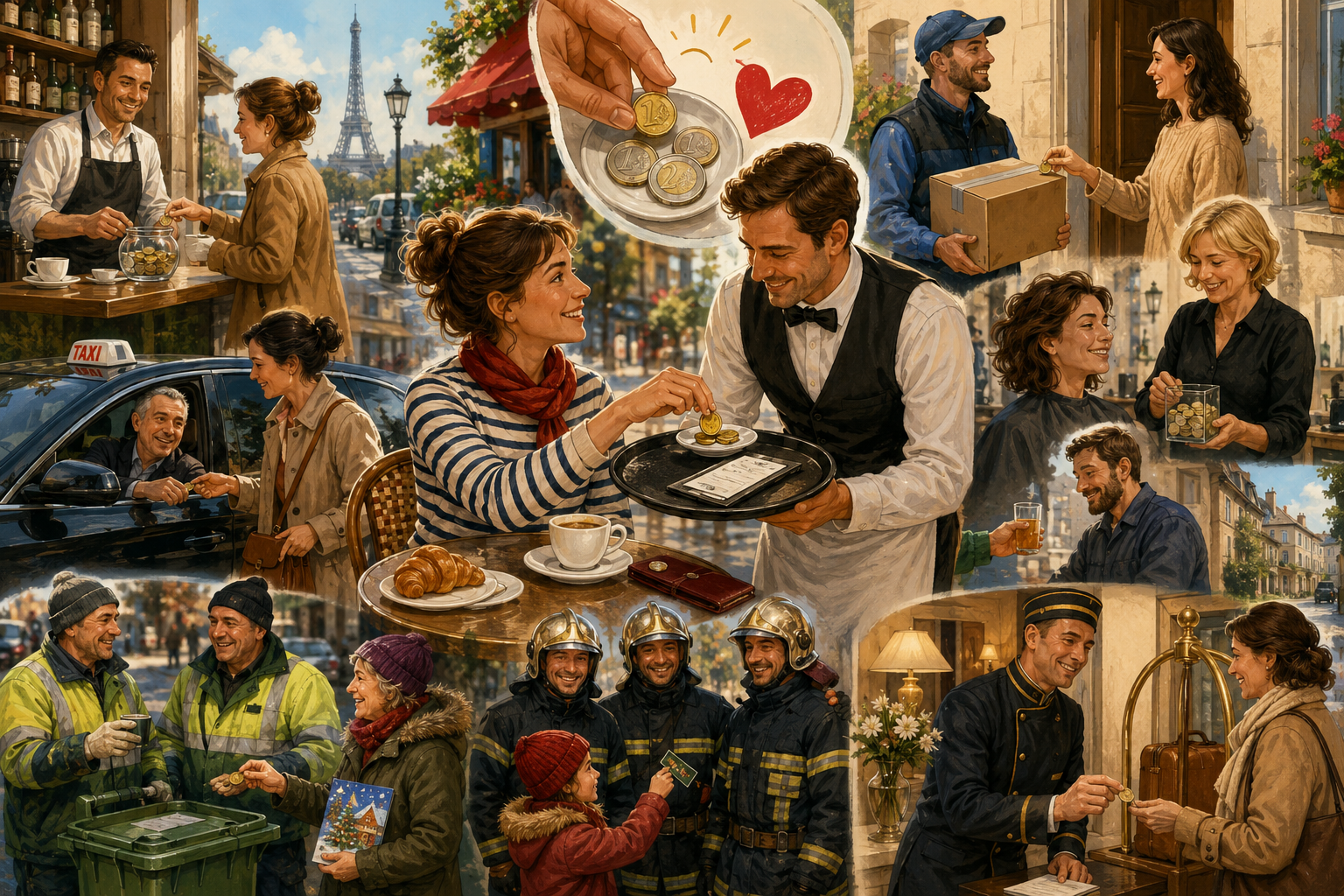
Did you know that the English word ‘tip’ was originally an acronym for ‘To Insure Promptness.’ Innkeepers would write this on a box by the door, later simplified to ‘T.I.P.’, to enable customers to show their appreciation of good service. The French word ‘pourboire’ means ‘in order to drink’, as the original intention was of course for the ‘tippee’ to have a drink on the ‘tipper’.
Do I need to tip in France?
The short answer is no – but it’s always appreciated.
Unlike in the UK, the US, Canada and many other countries, French service staff are paid a salary and restaurant bills already include a service charge. This means that tipping is not expected and certainly not obligatory.
If you look closely at your restaurant bill, you’ll usually see the words ‘service compris’ (SC) , ‘service et taxe compris’ (STC) or ‘prix nets/toutes taxes comprises’ (TTC)
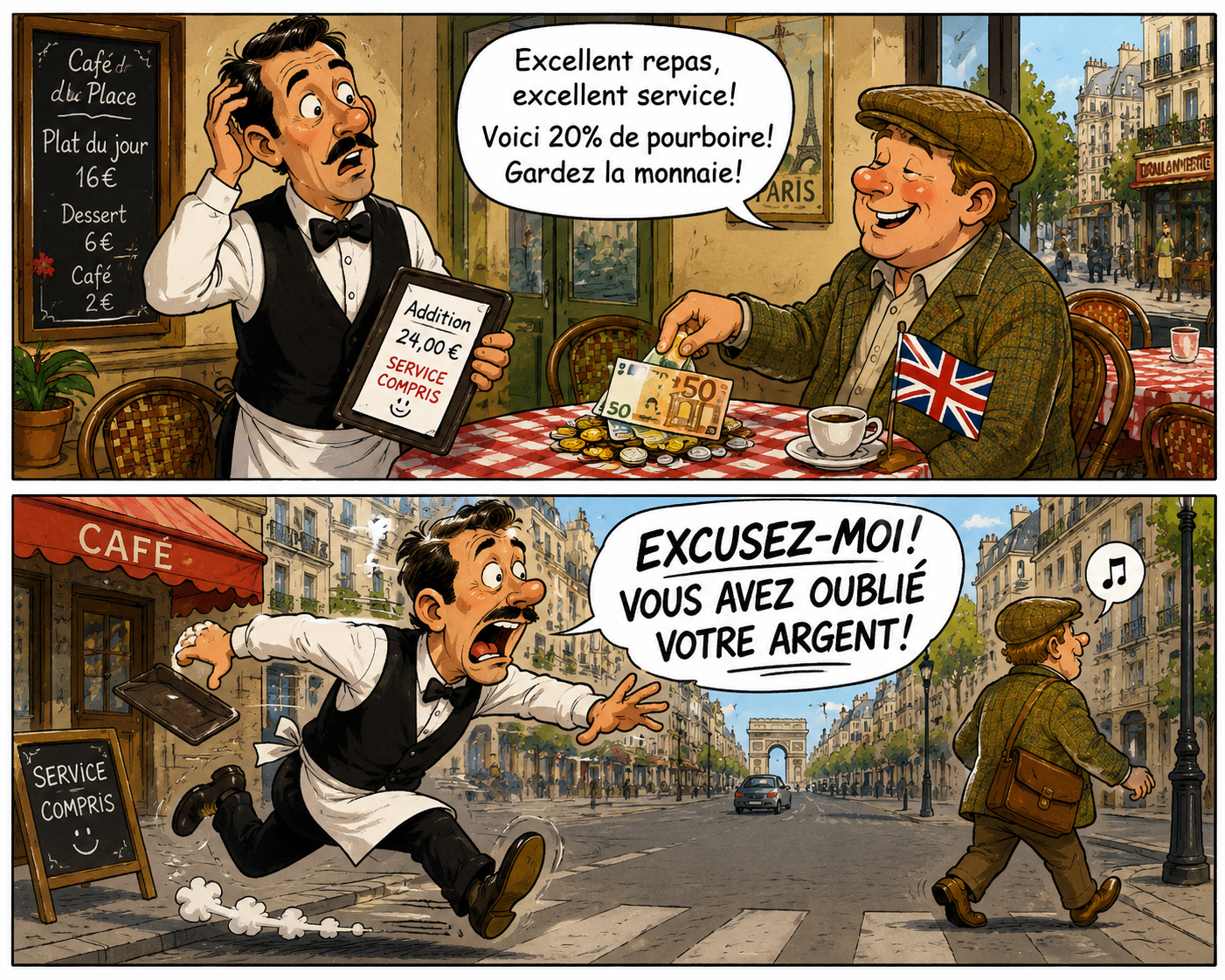
French law requires restaurants and cafés to display and include a service charge in their prices, meaning the amount shown on the menu is the amount you pay. There’s no need to calculate an additional percentage at the end of the meal which often comes as a relief to visitors from countries where tipping 15–20% is expected. In fact, when you leave a tip, you are really paying twice for your service.
Of course it is customary to reward good service, but when questioned, French people in the region recognised that their practices were not the same as in English-speaking countries!
So, Should You Leave a Tip?
If the service was good, many French customers will leave a small amount as a gesture of appreciation.
Typical examples include:
- Leaving the small change from the bill.
- Rounding up to the nearest euro.
- Leaving €1–€5 for particularly attentive service.
- Leaving a little more in an exceptional restaurant.
What is uncommon in France is adding a large percentage to every bill. A 10 or 20% tip would generally be considered very generous, and even a little over the top!
The Contactless Payment Problem
Twenty years ago, most people paid in cash and simply left a few coins on the table.
Today, with contactless cards and smartphones, many people carry little or no cash. As a result, tipping has become less frequent, even when customers are perfectly happy with the service.
You may occasionally see card machines suggesting a tip amount, particularly in tourist areas. Don’t feel pressured. Unlike some countries, tipping remains entirely optional in France.

What About Cafés and Bars?
For a coffee at the local café, a tip is not expected.
However, many regulars will leave a few coins after receiving friendly service, especially if they visit often.
The same applies to bars: rounding up the bill or leaving some change is a nice gesture but never an obligation.
Tipping Taxis
Most French passengers simply round up the fare.
For example:
- €18.40 becomes €20.
- €24 becomes €25.
If a driver has helped with luggage, waited patiently, or provided exceptional service, a little extra is always appreciated.
Hotels
Hotel tipping is generally modest.
Common examples include:
- €1–€2 per bag for a porter.
- A few euros for housekeeping after a longer stay.
- A small amount for a concierge who has gone out of their way to help.
Again, these are gestures of thanks rather than expectations.
Hairdressers, Beauticians and Tradespeople
Many clients leave a euro or two for hairdressers and beauticians if they’re pleased with the service.
For plumbers, electricians, builders or delivery workers, tipping is far less common, though offering a coffee, cold drink or snack is often appreciated, especially during hot weather.
The French View of Tipping
Perhaps the biggest difference between France and countries such as the United States is cultural.
In France, a tip is seen as a reward for particularly good service, not as part of someone’s salary. Service staff are not expected to rely on tips to make a living, which is why nobody will be offended if you leave nothing at all.
If you’re visiting France, remember:
- Service is already included.
- Tipping is optional.
- Small amounts are perfectly acceptable.
- Good service can be rewarded, but there’s no obligation.
- A smile and a sincere “merci” are often valued just as much as a few euros.
When in doubt, simply follow the French approach: tip if you want to, not because you feel you have to.
What the tippers say…..
Christian, retired garage owner
“Le service est très important. Pour un bon accueil, je donnerais deux à trois euros. Dix pour cent, ça fait beaucoup trop ! »
Eve, housewife
“Je donne aussi des pourboires au plombier (plumber), livreur (deliveryman), déménageur (removal man)…. s’ils ont été efficaces”
Bruno, financial director
“En France avec la généralisation du paiement par CB tu n’as plus de monnaie dans la poche car même pour payer le parking c’est par CB. Après ça reste exceptionnel le pourboire en France; il faut vraiment un serveur attentionné. Dans les pays anglophones, ça me choque pas de donner 10 a 20 % de pourboire selon la qualité du serveur”
Isabelle, teacher
“On ne donne pas suffisamment de pourboires en général, même si l’excuse est que les pourboires sont comptés dans l’addition. Par comparaison aux USA, on laisse 15 à 20% de l’addition en plus en pourboires. C’est comme ça que les serveurs sont (mieux) rémunérés. On devrait suivre ce modèle en France et alors peut-être que les patrons auraient moins de problèmes pour recruter ?”
Useful vocab un bon accueil – a warm welcome |
What the tippees say…..
Céline (restaurant owner)
C’est vrai que ça fait plaisir mais ce n’est pas du tout obligatoire. On ne doit pas se sentir obligé de donner un pourboire – on donne ou on ne donne pas. »
Christine (hairdresser)
« Bien sûr les pourboires ne sont pas obligatoires mais si un client ne donne rien, peut être qu’il n’est pas content. Nous, on met une boite à coté de la porte. Un à deux euros suffit. Les pourboires vont toujours aux employés, pas au propriétaire ».
Hélène (taxi firm owner)
Les Anglais trouvent que c’est cher de prendre un taxi en France mais c’est l’état qui décide la tarification, pas nous. Recevoir un pourboire est toujours agréable. Combien? Ah, ce n’est pas important – c’est le geste que compte !
David (builder)
“Dans le département c’est très rare. Les sommes vont de 5€ et encore plus rarement 20€ à 50€. Mais effectivement, bien sûr, on aimerait que ce soit plus courant parce que les clients demandent régulièrement des “petits services” qui sortent du cadre des travaux chiffrés. Du genre, “Puisque vous êtes là, pouvez-vous juste…” En plus, on bosse souvent dans des conditions difficiles- la Tramontane ou la canicule!”
| ça fait plaisir = it’s nice on ne doit pas se sentir = you shouldn’t feel ne donne rien = gives nothing on met = we put l’état = state la tarification = the pricing c’est le geste qui compte = it’s the thought that counts on aimerait = we would like plus courant = more common petits services = small favours puisque vous êtes là, pouvez-vous juste… = as your here, could you just… on bosse = we work |
Of course, Christmas tipping for the postman, (facteur) rubbish collectors (éboueurs) and firemen (sapeurs-pompiers) when they come round with their Christmas calendars, is always advisable to ensure smooth post delivery, rubbish collection or house-fire help. A contribution of €5 to €15 euros is much appreciated, and probably a worthwhile investment on your part!