
When the Saints Go Marching In
France may have been officially laïque (secular) since 1905, but in the Pyrénées-Orientales, religion, history and local tradition are often woven together so tightly that it can be difficult to separate one from another.
Across the department, villages and towns celebrate their patron saints with fêtes that can last several days. There may be religious processions, music, dancing, fireworks, giant figures, human towers, boats, food and, quite often, an impressive amount of noise.
For visitors, these celebrations can seem wonderfully exuberant. For locals, they are also a way of keeping alive the traditions and identity of this corner of Catalonia.
So, who exactly are all these saints whose names appear on festival programmes?
First, expect a Festa Major
Before meeting the saints themselves, it helps to understand the Festa Major.
Almost every town and village has a patron saint, and the annual festival in their honour is one of the highlights of the local calendar. The religious element might be a procession or Mass, but the celebration quickly spills out into the streets, with concerts, dancing, fireworks, children’s activities and traditional Catalan performances.
And there are some things you are particularly likely to encounter.
Sardanes
The sardane is probably the most recognisable of Catalan dances: dancers form a circle, holding hands and making small, precise steps to the music of a cobla, the traditional Catalan ensemble.
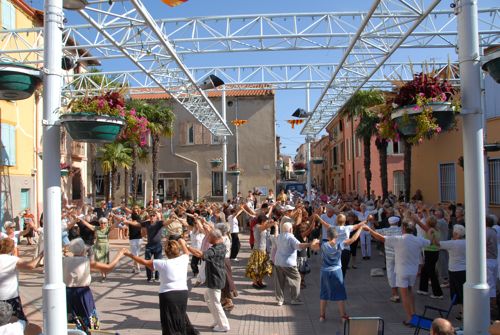
It looks deceptively easy. It isn’t.
The apparently simple choreography demands concentration, coordination and surprisingly good leg muscles. And there is something rather lovely about watching experienced dancers effortlessly join a circle with complete strangers.
The sardane also acquired a much deeper significance during the Franco dictatorship, when expressions of Catalan culture were restricted. The dance became a quiet but powerful symbol of Catalan identity.
Today, it is simply part of everyday festive life throughout Catalonia, including here in the P-O.
Correfocs
If the sardane represents the gentle side of Catalan tradition, the correfoc is its considerably more alarming cousin.
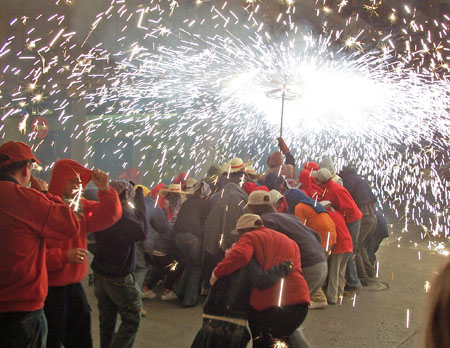
Literally meaning “fire run”, a correfoc involves groups of diables—devils dressed in horns, masks and red or black costumes—running and dancing through the streets amid fireworks and showers of sparks.
It is spectacular, noisy and intentionally chaotic, with spectators often encouraged to get surprisingly close to the action.
The tradition has its roots in Catalan popular culture and folklore, with the devils and fire representing the battle between good and evil. If you attend one, sensible clothing and sturdy shoes are considerably more useful than your best Sunday outfit.
Castells
Then there are the castells: human towers which can reach several storeys high.
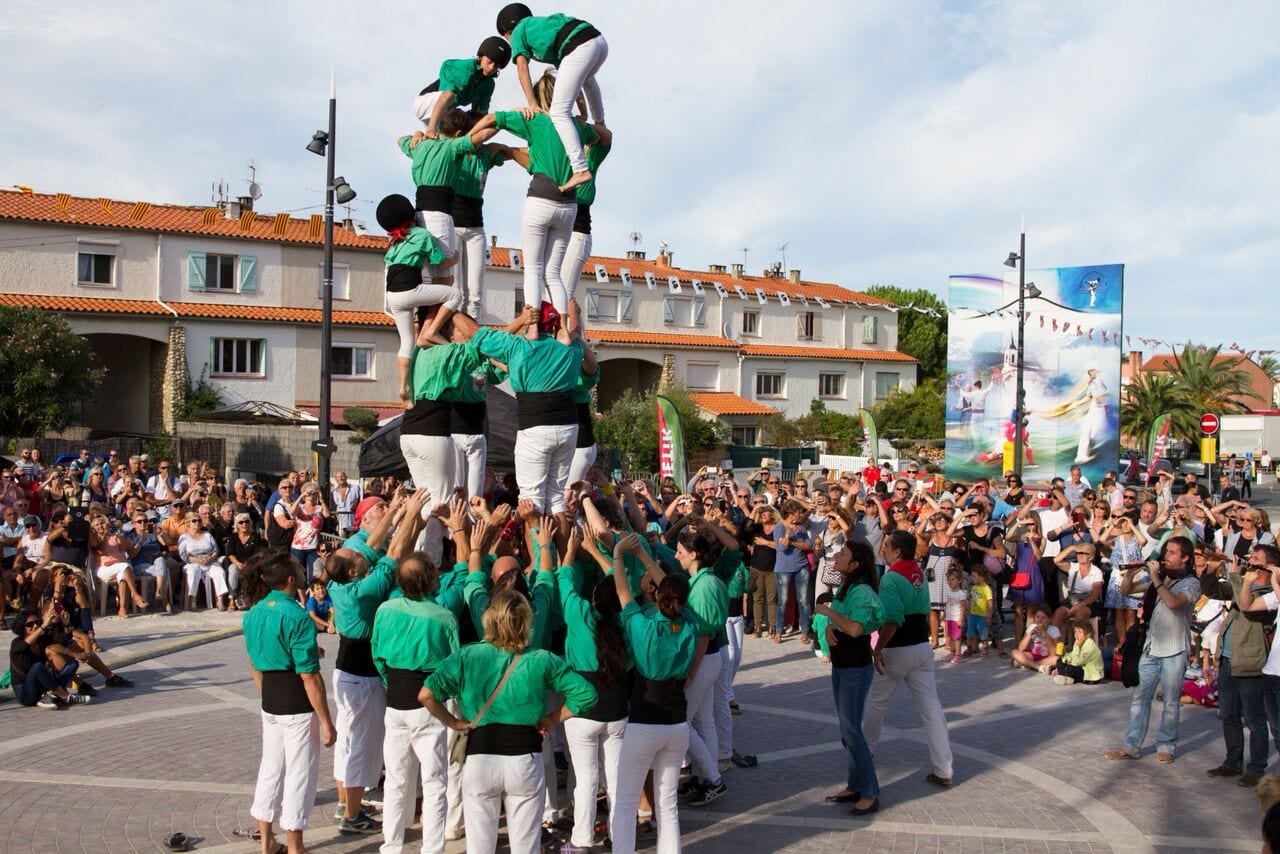
At first glance, they might look like an extraordinary piece of festive entertainment. Watch for a little longer, though, and it becomes obvious that there is an enormous amount of skill and organisation involved.
The people at the bottom form the pinya, creating the solid human foundation on which the tower depends. Above them, successive levels climb into position until, eventually, the smallest participant—the enxaneta, usually a child—reaches the top and raises four fingers.
That final gesture traditionally represents the four red stripes of the Catalan flag.
The tower is then dismantled, often almost as quickly as it was built.
And then there are the saints.
Saints Abdon and Sennen: the storm stoppers
On 30 July, the village of Montbolo honours Saints Abdon and Sennen with one of the department’s more unusual traditions.
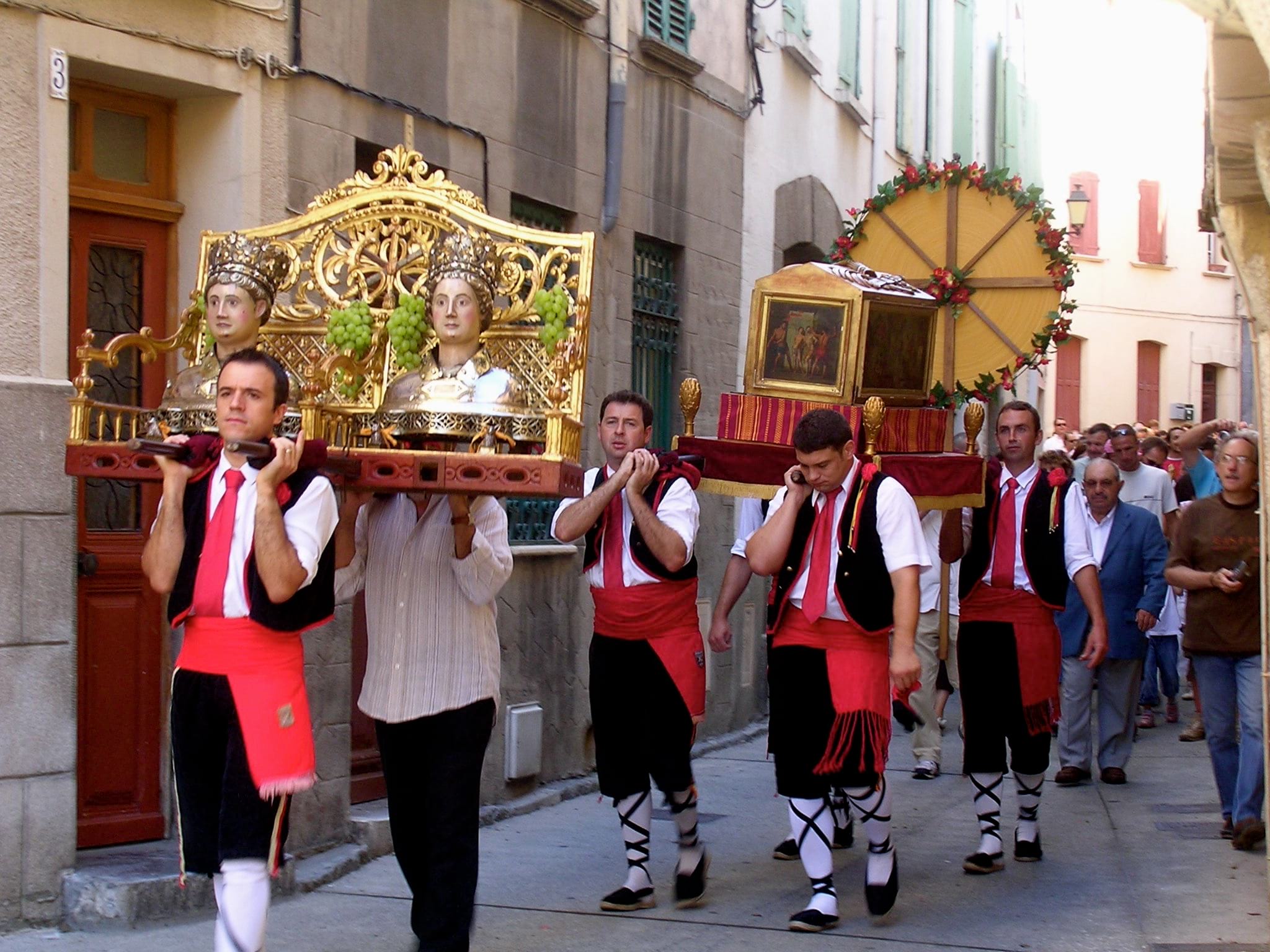
The centrepiece is the Rodella, an enormous coil of beeswax wrapped in a spiral around a flower-covered cross. It is carried from Montbolo to Arles-sur-Tech in a procession which sets off early in the morning and follows paths through the countryside.
The story behind it is wonderfully dramatic.
According to local tradition, in 1465 a shepherd from Montbolo saw two witches plotting to unleash a devastating storm on the village. Saints Abdon and Sennen intervened, preventing the storm from reaching Montbolo and forcing the witches to divert it elsewhere.
The villagers, their crops saved, promised to honour the two saints every year.
And so they still do.
The Rodella is carried to Arles-sur-Tech, where the celebrations continue, while holy water is distributed and smaller versions of the wax offering are available to buy.
Whether you regard the miniature Rodella as a charming souvenir or a personal weather-protection device is entirely up to you.
Find out more here.
Saints Côme and Damien: the doctors who became protectors
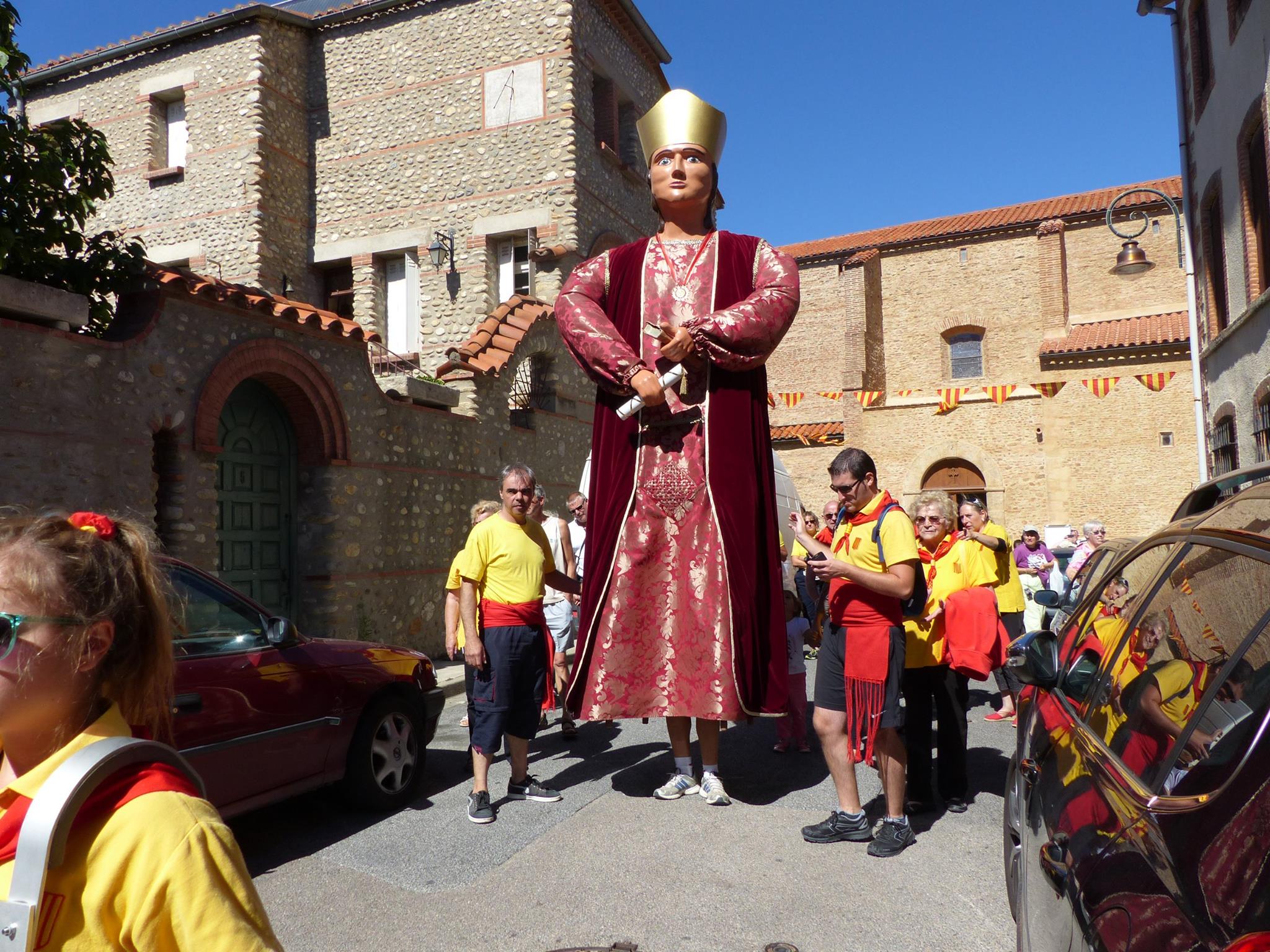
Towards the end of September, Argelès-sur-Mer celebrates its patron saints, Saints Côme and Damien.
The twin brothers are said to have been born in Syria during the third century. Both became doctors and, according to tradition, treated people without asking for payment. They were eventually arrested and executed during the persecution of Christians and became Christian martyrs.
Their association with Argelès dates back to the plague.
Local tradition tells how the town suffered a devastating epidemic in the 17th century. The plague finally disappeared on 27 September 1652—the feast day of Côme and Damien.
The people of Argelès made a vow to honour the two saints every year in gratitude.
Centuries later, the festival is rather more cheerful than the circumstances that inspired it. There are processions, music, dancing, sardanes, giant figures and castellers, turning the streets of Argelès into one enormous celebration of local history and tradition.
Find out more here.
Saint Vincent: Collioure takes to the water
In Collioure, Saint Vincent is the man to know.
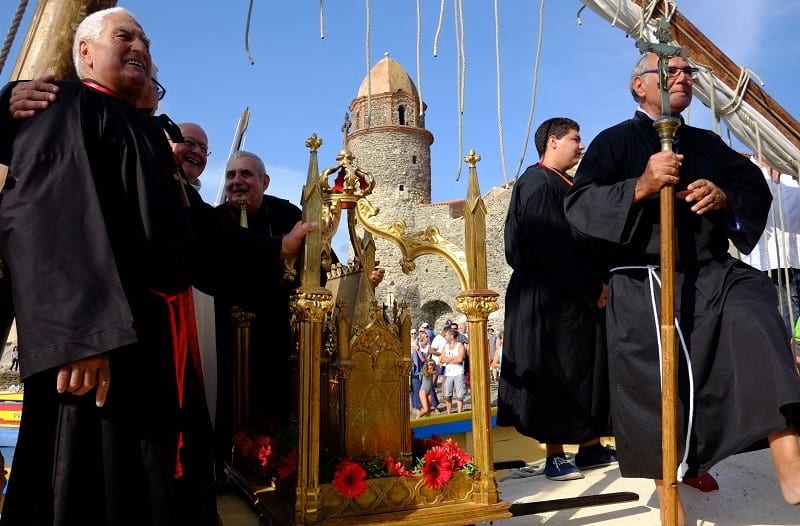
The town’s patron saint is honoured during the festivities held in August, traditionally around the third week of the month. The origins of the celebration date back to 1701, when relics associated with Saint Vincent were returned to Collioure.
Vincent is traditionally said to have been a Christian martyr, and local tradition connects him particularly closely with Collioure and its fishing community.
Given the town’s maritime history, it is perhaps no surprise that the celebrations have a distinctly watery character.
There are fishing boats, maritime processions, concerts, parades and competitions, including the famous ronde du clocher, in which participants swim around the harbour and bay.
One of the most striking events is the procession sur la mer, when the celebration moves from the streets onto the water.
It is a reminder that in coastal Catalonia, saints, fishermen and the sea have long been part of the same story.
Find out more here
Saint Jacques: pilgrims, harvests and Canet
In Canet-en-Roussillon, the July celebrations are dedicated to Saint Jacques—Saint James the Great, one of the twelve apostles of Jesus.
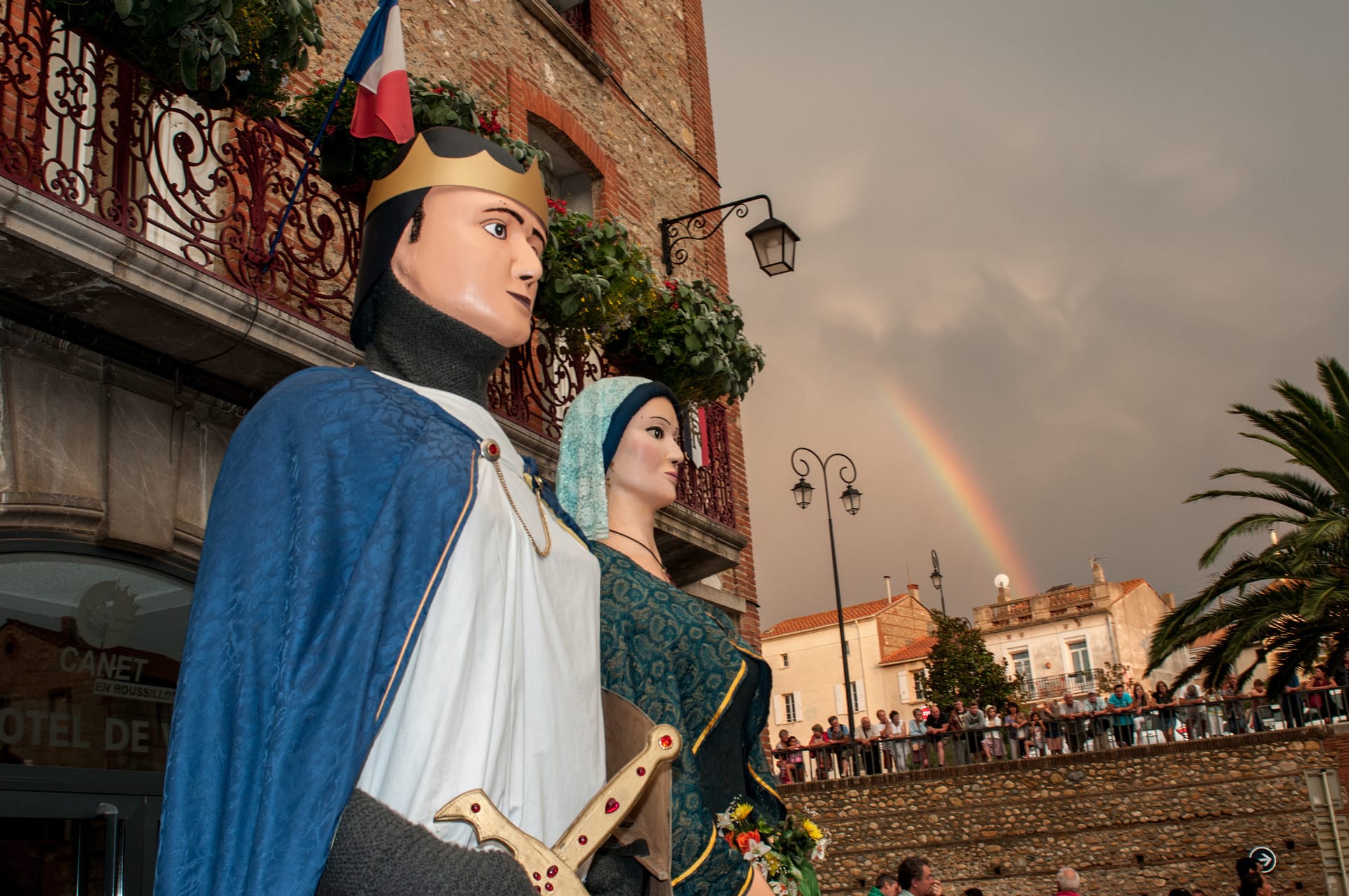
Saint Jacques is, of course, inseparable from the great pilgrimage to Santiago de Compostela in north-west Spain. Canet has long been connected with routes used by pilgrims travelling towards Santiago, and the tradition of welcoming travellers has left its mark on the town.
According to local tradition, celebrating Saint Jacques would help bring a good harvest and protect the community.
There is something particularly appropriate about honouring a saint associated with one of Europe’s great journeys in a town which has itself been a stopping point for travellers for centuries.
Today, the Saint Jacques festivities combine the religious heritage with the music, food and entertainment expected of a Festa Major.
Find out more here.
Saint Pierre: patron saint of fishermen
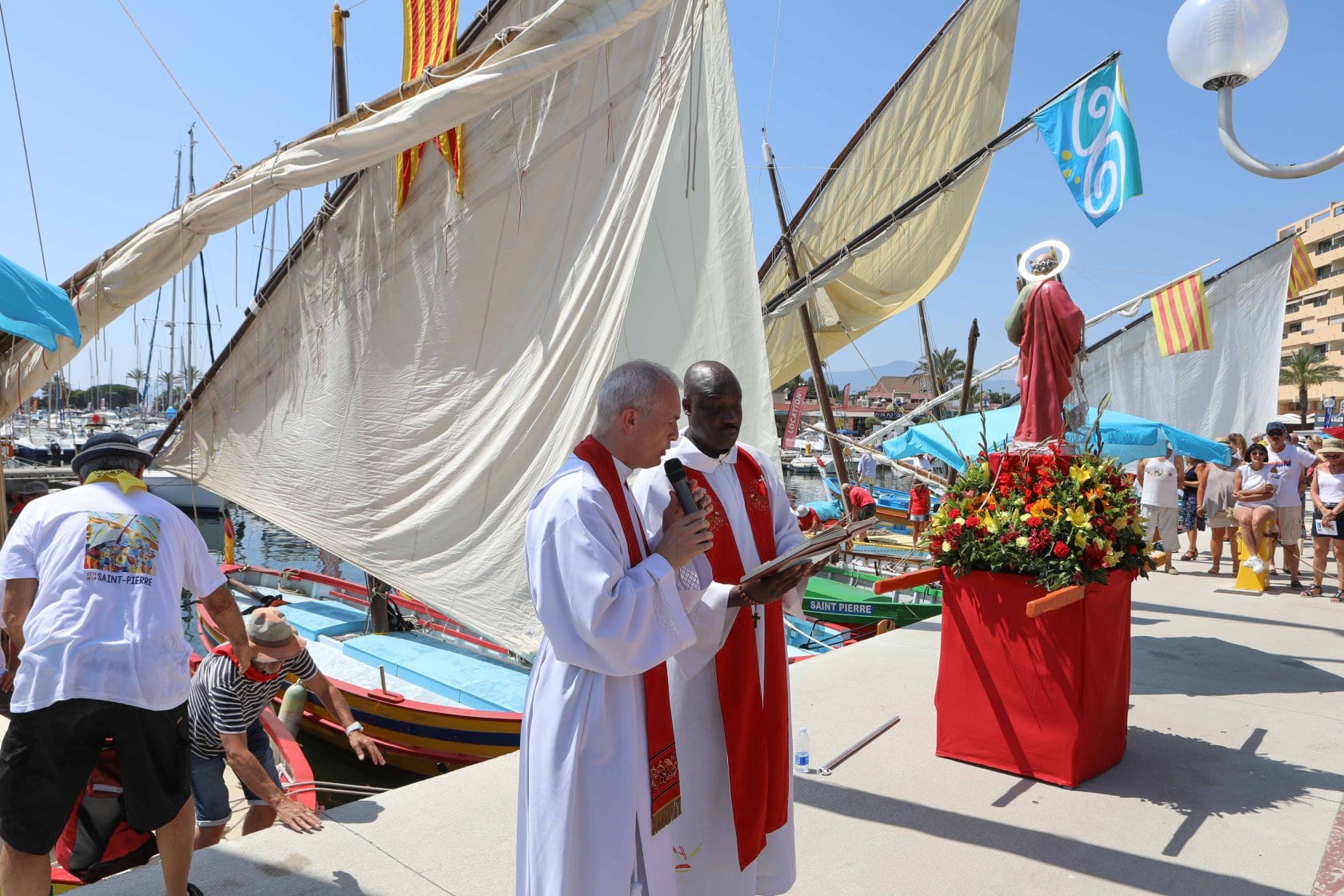
And then there is Saint Pierre—Saint Peter—whose connections with the Mediterranean make him particularly important in the Pyrénées-Orientales.
According to Christian tradition, Peter was a fisherman before becoming one of Jesus’s apostles and is regarded by Catholics as the first pope.
He has accumulated an extraordinary list of patronages over the centuries. Because of his former occupation, however, it is his connection with fishermen and the sea that is particularly relevant here.
Saint Pierre is traditionally associated with fishermen, sailors, shipbuilders and others whose lives depend upon the water. Consequently, coastal communities across the department celebrate him in various ways.
And there is a certain logic to this.
For generations, fishing was not simply an occupation along this coast. It was a way of life, and the sea could provide a living one day and take it away the next. Having a patron saint looking after fishermen was therefore a matter of some importance.
And then there is L’Assomption
No discussion of August festivities in France would be complete without l’Assomption, the Feast of the Assumption, celebrated on 15 August.
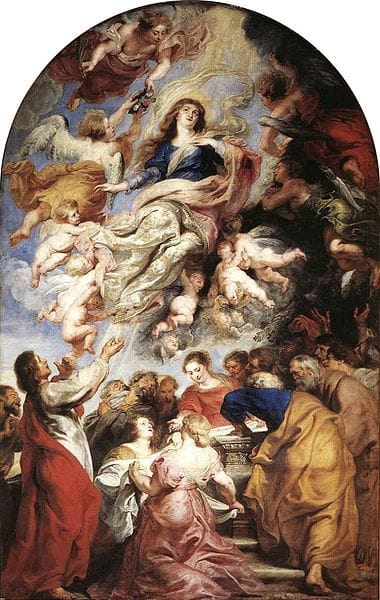
The feast commemorates the belief that Mary, the mother of Jesus, was taken body and soul into heaven at the end of her earthly life.
It is one of France’s national public holidays, and in the Pyrénées-Orientales it arrives at exactly the right moment: the height of summer, when the coast and mountain villages are already buzzing with visitors and local celebrations.
The history of the public holiday is rather more interesting than you might expect.
In the 17th century, Louis XIII, who had been married for many years without producing a male heir, made a vow to consecrate France to the Virgin Mary. He asked for processions to be held throughout the kingdom on 15 August.
The following year, in 1638, his son Louis XIV—the future Sun King—was born.
The story helped cement the importance of the Assumption in France, and 15 August has remained a major date in the French calendar.
Here in the P-O, the religious significance is only part of the story. For many people, it is also simply one of those glorious midsummer dates when there is a fête somewhere nearby.
Find out more here.
More than saints
What makes these festivals so fascinating is that they are about considerably more than religion.
They are about Catalan identity, local history, fishing traditions, farming, folklore, music and the simple pleasure of a village or town getting together to celebrate.
You don’t have to be religious to appreciate them.
You might arrive for the fireworks and stay for the sardane. You might go to see the castells and find yourself fascinated by the teamwork. You might cautiously approach a correfoc and discover that standing close to flying sparks is considerably more exciting than it sounds.
Or perhaps you’ll simply find yourself standing in a village square on a warm summer evening, watching generations of the same family dance together while the music of the cobla drifts through the crowd.
The saints may provide the excuse.
The celebration belongs to everyone.
SOME YEARLY DATES FOR YOUR DIARY
Exact programmes and individual events can vary from year to year, so it’s worth checking with the local tourist office before setting off. This saintly calendar also provides a rather good excuse to explore the P-O
Around 29 June
Saint Pierre
Coastal towns and fishing communities
July
Saint Jacques
Canet-en-Roussillon
End of July
Saints Abdon & Sennen (Fête de la Rodella)
Montbolo → Arles-sur-Tech
15 August (Invariable)
L’Assomption
Throughout the P-O
Around the third week of August
Saint Vincent
Collioure
Late September
Saints Côme & Damien
Argelès-sur-Mer