
Puigcerdà
Founded in 1177 by King Alfonso I of Aragon, Count of Barcelona, Puigcerdà, meaning “Cerdanyan hill” in Catalan, replaced Hix (now a village in the French part of Cerdagne) as the capital of Cerdanya in 1178.
Located at 1,202 metres above sea level, by the river Segre, and just over the (non existant) French border, it’s difficult to know when to stop saying bonjour and start saying holà! Today, despite occasional border controls during exceptional periods, Puigcerdà remains firmly part of the everyday cross-border life of the Cerdanya plateau, with residents commuting, shopping and socialising freely between France and Spain.
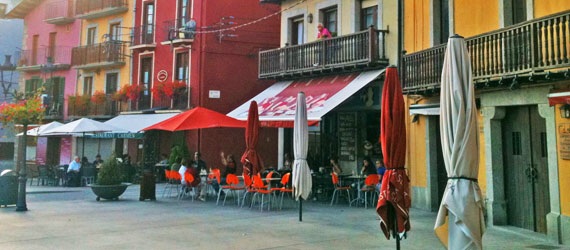
Puigcerdà was unique during the Spanish Civil War in having a democratically elected Anarchist council.
If you arrive like I did, on a winter’s night over the festive season or half term holidays, from the slow calm of the small villages of Bourg Madame or Porté Puymorens above Font Romeu, you are in for quite a surprise. The town is crackling! Bars and restaurants, classy shopping precincts, hot chestnuts and churros stands, bright lights, casino, floodlit frozen man-made lake (built in the 14th century to irrigate the surrounding farmland) with very cold ducks and swans…..
The lake and surrounding park remain the town’s social heart, recently enhanced with improved walkways and family-friendly spaces, making it a popular meeting point in every season.
While winter is undeniably Puigcerdà’s most animated season, the town is no longer just a cold-weather destination. Summers now bring hiking, cycling, lake-side cafés and festivals, with the high altitude offering welcome relief from the heat of Barcelona and the plains below.

This town is apparently a great favourite with the Barcelonans, who buy holiday homes here and come up for weekends to ski or just chill. Puigcerdà has also built a strong reputation for dining, combining traditional Cerdanya mountain cuisine with contemporary Catalan cooking, tapas bars and pastry shops that draw visitors from both sides of the border.
For skiers, Puigcerda can be an excellent base for daily ski trips as long as you don’t mind a 30 minute drive.
La Molina – Masella (Spain) and Font Romeu (France) are close by as well as Pas de la Casa (Andorra).
In fact, the plan, several years ago, was to to link Porté Puymorens, a fifteen minute drive from Puigcerda, with the vast skiing domain in Andorra, Granvalira, making it the largest skiing area in the Pyrenees, with a total of 270 km of pistes.
The ambitious project was ultimately abandoned for environmental and economic reasons, but the discussion highlights Puigcerdà’s strategic position at the crossroads of several major Pyrenean ski areas — a role it continues to play today.
Lively yet rooted in history, Puigcerdà remains a place of contrasts — Catalan and French, rural and cosmopolitan — and one of the most distinctive towns in the eastern Pyrenees.