
The Master of Cabestany
Follow the eyes. That is perhaps the best advice for anyone setting out to discover the mysterious Master of Cabestany.
Look closely at a Romanesque sculpture in the churches and abbeys of the old Mediterranean world and you may notice them: enormous almond-shaped eyes staring out from the stone, long expressive fingers, deeply drilled details and faces that seem strangely alive after almost nine centuries.
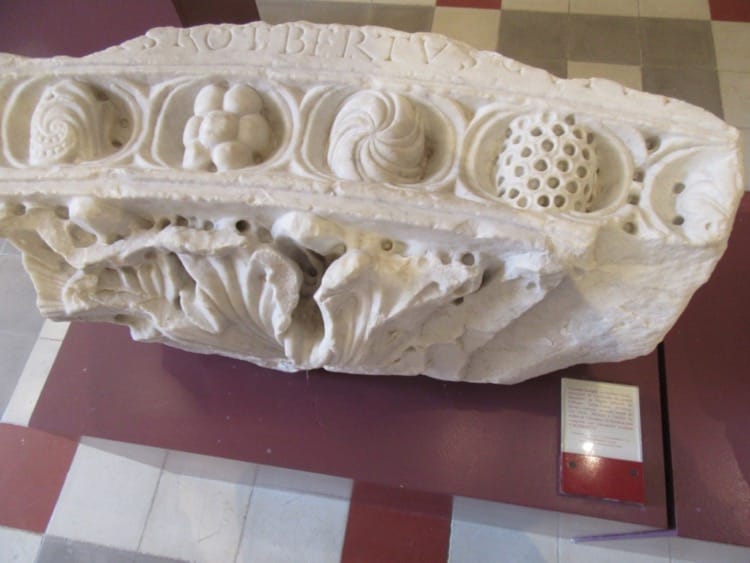
But who carved them? We don’t actually know.
The man we call the Master of Cabestany (for we assume it was a man) left no signature, no biography and, as far as we know, no written record identifying him. “Master of Cabestany” is simply the name modern art historians have given to the anonymous sculptor – or perhaps the workshop – responsible for a remarkable group of Romanesque sculptures created during the second half of the 12th century.
And here in the Pyrénées-Orientales, you can follow his trail, which begins, appropriately enough, in Cabestany.
Cabestany – where the mystery begins
Just a short drive from Perpignan, the village of Cabestany seems an unlikely place to begin one of the great mysteries of medieval art, yet this is where the Master’s story was rediscovered.
During restoration work on the village church , Notre-Dame-des-Anges in Cabestany, in the early 20th century, a magnificent marble Romanesque tympanum was identified. It had been reused in the medieval building, its original setting and history forgotten.
Once scholars began examining it closely, however, they realised that this was no ordinary piece of Romanesque sculpture. The carving was quite extraordinary, the faces intense., the drapery deeply cut and full of movement. The figures had those unmistakable, almost hypnotic eyes. And the subject matter was equally fascinating: scenes surrounding the death, resurrection and assumption of the Virgin Mary.
One particularly intriguing detail shows the apostle Thomas receiving Mary’s belt.
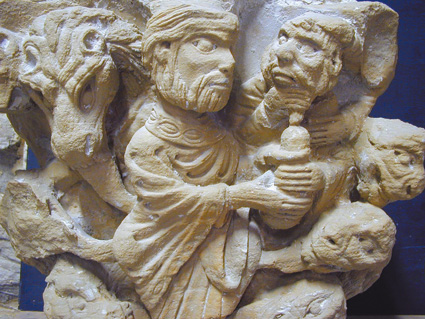
According to an ancient Christian legend, Thomas was absent when Mary was taken into heaven. When he refused to believe the other apostles’ account, Mary dropped her belt from heaven as proof of her Assumption.
It is a wonderful medieval story – part miracle, part detective tale – and the anonymous sculptor chose to preserve it in marble.
The discovery of the tympanum eventually led scholars to search for other sculptures bearing the same distinctive characteristics….and that is when the trail began to grow.
Your first stop: the Centre de Sculpture Romane
Before setting off in search of the originals, visit the Centre de Sculpture Romane – Maître de Cabestany.

The centre in Cabestany brings together reproductions of sculptures attributed to the Master and his workshop, allowing you to see details from different churches and countries side by side. Look for the eyes. Look at the fingers. Look at the folds of the clothing and the way the figures seem to twist and move within the stone. – and commit them to memory ready for the next stop.
Le Boulou – look up at the doorway
From Cabestany, head south towards Le Boulou.
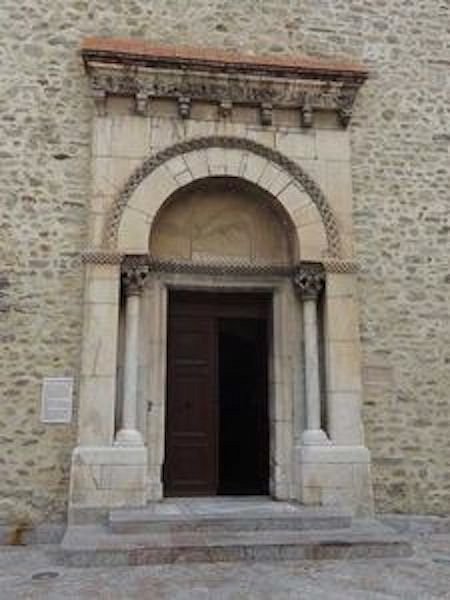
The town is famous today for its thermal waters, but its Romanesque church, Sainte-Marie, contains something considerably older and more mysterious.
Take your time before going inside, the real treasure is around the Romanesque doorway, sculpted with scenes from the childhood of Christ: the Annunciation to the Shepherds, the Nativity, the Adoration of the Magi and the Flight into Egypt, biblical stories turned by the Master into something that could be understood by people who could not read.
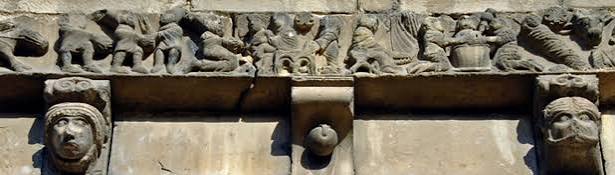
And once again, look at the faces. Do you recognise them?
The attribution of individual sculptures within this widespread corpus can be complicated – scholars continue to debate precisely which works were carved by the Master himself and which belong to his workshop or artistic circle. But the distinctive style is unmistakable enough to have connected monuments hundreds of kilometres apart.
This is the first lesson of following the Master’s trail: you are not following a signature. You’re following a style.
Monastir del Camp – a monastery in the vineyards
Continue towards Passa, where the little former monastery of Monastir del Camp sits among the vineyards.
It is a wonderfully atmospheric place to encounter Romanesque sculpture.
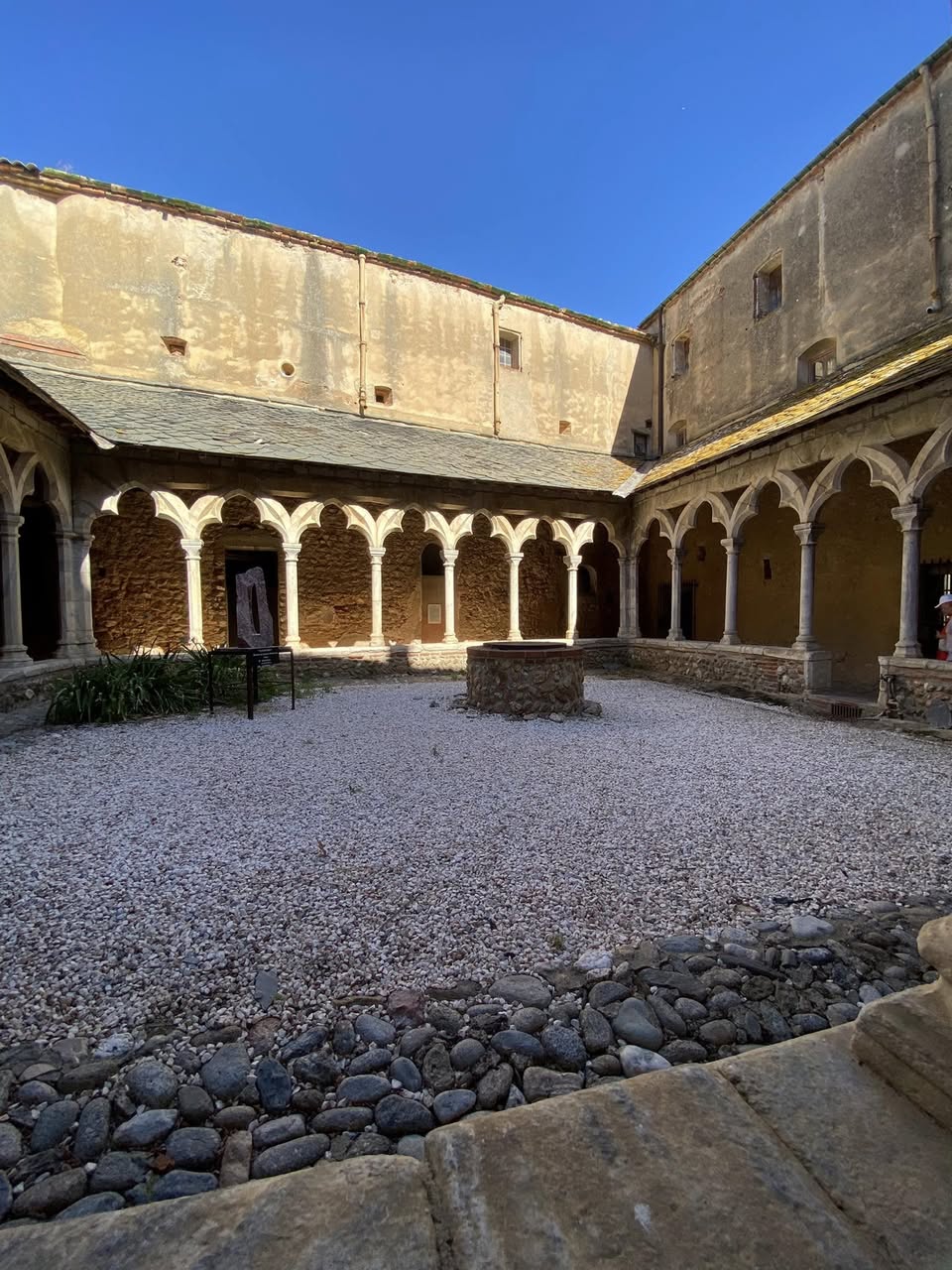
In the 12th century, major religious buildings were centres of power, wealth, learning and artistic patronage. A talented sculptor could be commissioned by monasteries and churches in different territories. The Master appears to have been extraordinarily mobile – or to have belonged to a workshop whose influence travelled widely.
Either way, his artistic fingerprints turn up in places that today cross international borders – which brings us to one of the great unanswered questions:
Was there really one Master?
The great mystery – one man or a workshop?
The name suggests a single artist. In fact, more than 120 sculptures and fragments have been associated with the Master of Cabestany and his workshop, spread across southern France, Catalonia, Navarre and Italy, so it is quite difficult to imagine one medieval sculptor personally producing everything attributed to him. He won’t have been able to travel around with Ryanair!
Perhaps he travelled from one commission to another. Perhaps he established a workshop whose craftsmen carried his techniques with them. Perhaps several artists worked in a closely related style. We simply don’t know. And that uncertainty is part of what makes the trail so fascinating.
Unlike Michelangelo or Rodin, whose names are inseparable from their masterpieces, the Master of Cabestany is known almost entirely through his work. The sculptures survived but the artist disappeared.
Rieux-Minervois – Mary carried into heaven
The trail now crosses into the Aude and leads to Rieux-Minervois. The village church of Sainte-Marie is unusual in itself: its remarkable circular design makes it one of the region’s most distinctive Romanesque buildings.
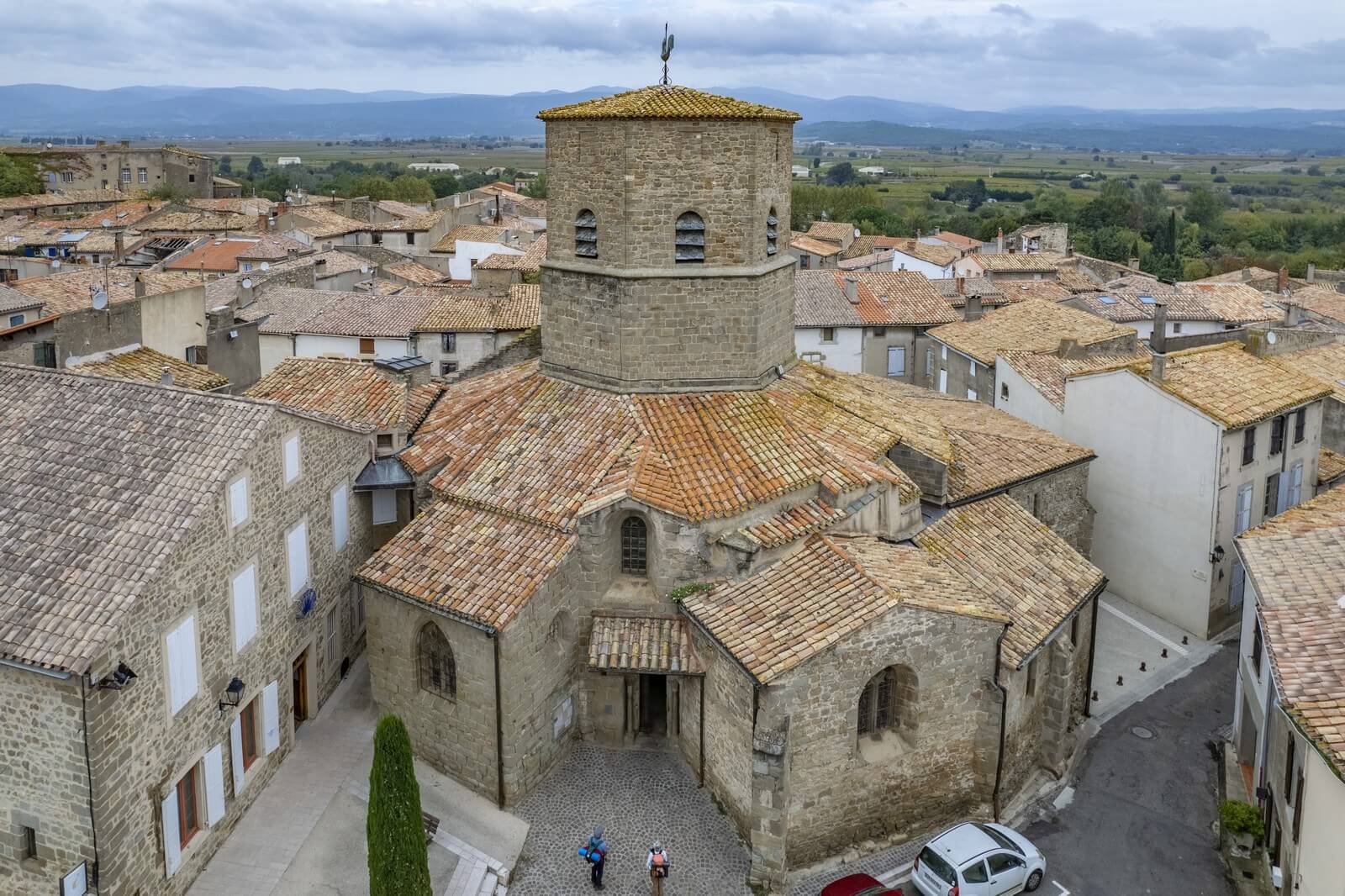
Inside is another sculpture associated with the Master and his workshop: the Assumption of the Virgin, in which Mary is enclosed within a mandorla and carried towards heaven by angels. Stand close and examine the details. From a distance, you see the story. Up close, you see the personality of the carving.
Saint-Hilaire – a murder carved in marble
On now, further west, to the former Benedictine abbey of Saint-Hilaire where our story becomes darker.
The abbey contains a remarkable marble sarcophagus traditionally associated with the Master of Cabestany, depicting the martyrdom of Saint Sernin (Saint Saturnin), the first bishop of Toulouse according to Christian tradition. His refusal to participate in pagan worship was said to have led to his death.
His punishment was brutal. He was tied to a bull and dragged through the streets until he died.
The sculptor turns this violent legend into an extraordinary sequence of carved scenes, figures crowded around the action, bodies twist.ed – and those eyes watching.
Saint-Papoul – Daniel and the lions
The final stop takes us to Saint-Papoul Abbey where we meet another of the great biblical stories represented in the Master’s circle: Daniel in the lions’ den.
Daniel has been condemned to death, yet the lions do not harm him. The story is one of faith surviving apparently impossible circumstances – a theme that would have resonated strongly within a medieval monastery, and is populated by lions, birds, monsters, musicians and strange faces.
Look at the eyes.
So, next time you find yourself standing in front of a Romanesque doorway in the Roussillon or the Aude, don’t just walk past, look at the eyes.
You may have found the Master.